Took me ages to write these up as I kept being side tracked by puzzles that endlessly went around in circles.
For the clever folks out there: Do you know why using the Newtonian equations for each planet doesn’t return the exact same value for G … or that the calculated orbital velcoities using the known masses and distances, eta, doesn’t quiet match up to their recorded? (even when considering uncertainties)
Chapter Three: Throwing a Ball
Okay, so we’ve seen how mass can work on a large, astronomical scale. But how does how does that look on Earth with smaller objects?
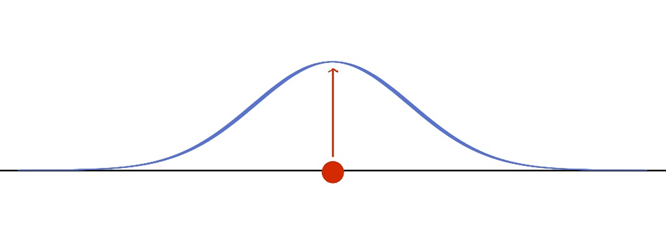
Just like in the planet-sun example earlier, the Gravitational Field warps around all mass. Not just massive bodies like planets and stars. But all matter, from the largest Black Hole to the tiniest dust mote. Everything.
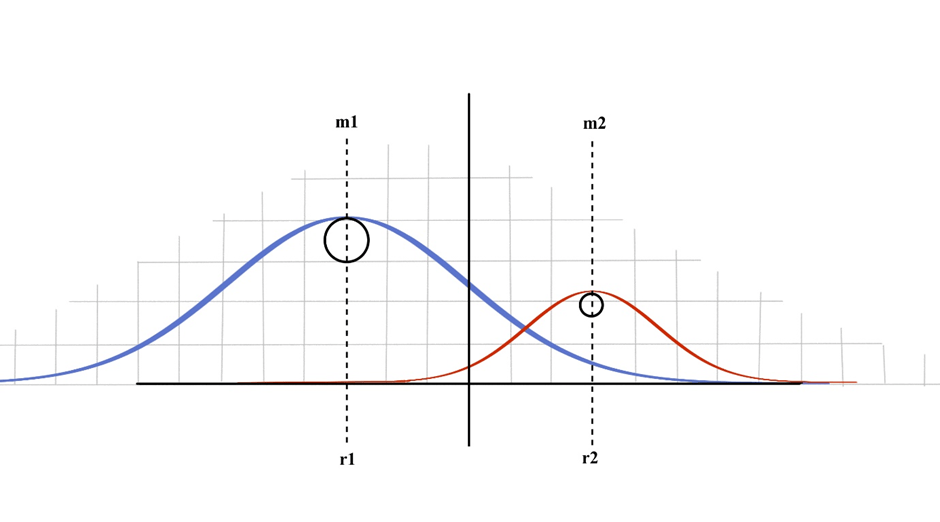
And, when you have two or more masses within reach then they will be drawn to each other. Just like our star-planet example, and this also applies to everything. The only difference is that unlike the examples above (And in previous chapters) the Primary mass is so dominant that we can effectively ignore the contribution of the smaller mass altogether.
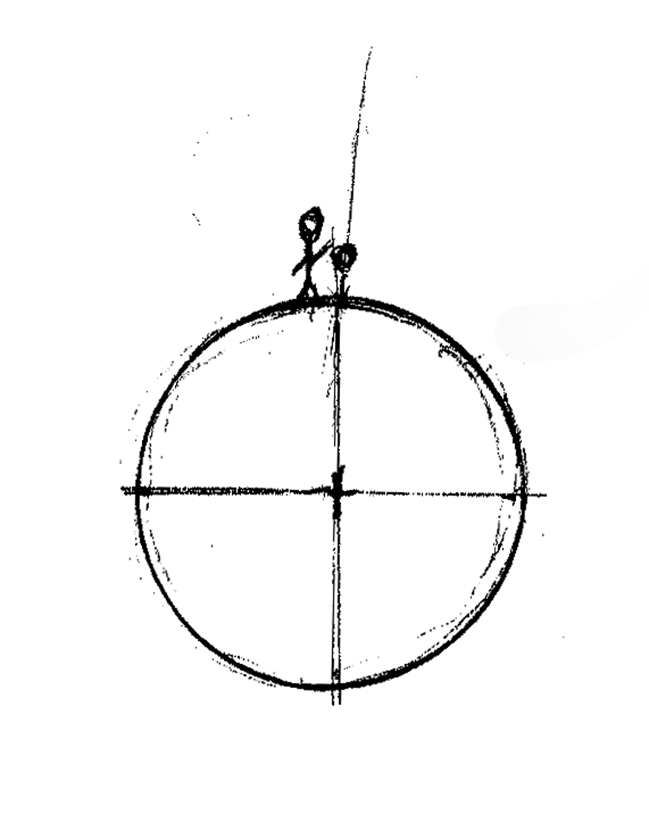
This ridiculous, flat-earther triggering, overly exaggerated image shows a non-descript stick figure dropping a ball. Said ball falls to the Earth for the exact same reason why the two bodies in the previous chapter are drawn to each other. Because the line of sight between the two bodies cancels out the effect of gravitational pressure beyond the Lagrange/neutral point between the two masses.
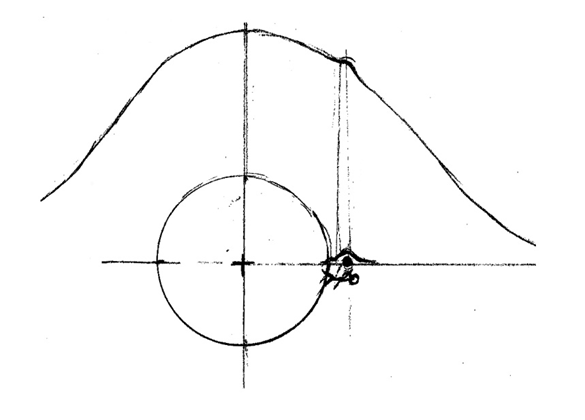
If we apply our gravitational field distortion to the ball and the planet — and rotate our cartoonishly-small world around — then we get our familiar picture (ignoring the unco, skewered bellcurve) And just like before, their distortions are accumulative.
The difference is (when we picture this on proper scales), the ball is SO SMALL and the planet SO BIG, that the ball’s contribution to the Gravitational Field’s distortion barely makes a difference and the point where the two gravitational pressures are equal is so close to the centre of the ball that it my-as-well be the centre. So we can ignore the small body’s mass.
The most important information in this scenario is that the line of sight still exists. And as such we still have both bodies drawn to each other.
You might struggle to imagine this (as I did) – it seems that the cancelling out pressure between the two objects would cause the larger mass to hurtle towards the ball at a pace as dramatic as the ball falling to the planet. But it’s all relative.
Two things I’d like to point out:
First, When you compare two masses you get both: the Lagrange point (L1), and the centre of mass (CoM).
L1; as stated, is the point where the gravitational pressure that draws things to each body cancels out, and is basically at the centre of the ball.
But the centre of mass is the point where two falling objects would eventually meet. So in the scenario of a ball falling to the planet, the centre of mass will be so close to the centre of the planet that there is no discernible shift.
Second, The mass area of the Planet is so huge, that the gravitational pressure lines are almost parallel to the ball’s line of sight. That gravitational pressure outside the ball’s influence is still bearing down on the planet without interruption. The small, gravitational blip caused by such a tiny area (from the ball) seems insignificant from the point of view of the planet. And that’s the important factor. The sphere of influence of the smaller mass.

So, a simple recap we have:
The entire, overwhelming force of the gravitational pressure bearing down on an ~8cm ball.
And though the planet does get pushed towards the ball as well. Its movement is minuscule in comparison, to the point it can be ignored.
The combined centre of mass of the two masses would be the point at which both masses would meet. (if there wasn’t an annoying thing, like the ground, in the way).
Chapter Four: Orbiting Bodies
Slight detour before we get into the orbiting chapter (Can skip to “Orbiting Mechanics” heading.
(Side Note: There are a lot of hand-drawn pics from now on in, cause I’m too lazy to recreate them digitally)
Thought I’d put in some “kind of” General Relativity visual aids to show how I’m picturing some things. I found myself picturing my idea in two ways: From a stretched gravitational field line perspective (Like GR), and a gravitational pressure/density perspective.
Below is nothing new from the norm. It’s the same as any General Relativity image of an orbiting body. You can look up “General Relativity Orbiting Bodies and Space Curvature” to get a better picture than my dodgy hand-drawn pics. The field lines represent the field being stretched in that plane.
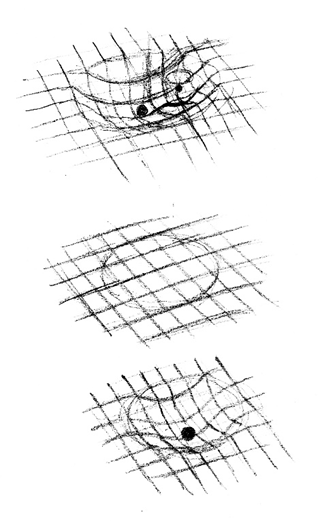
Bottom – one body
I don’t see this so much as space itself being stretched, but as the gravitational field that is being stretched (I’ll probably backtrack and/or change that statement down the line) and this affects how things behave within that field.
So, how do I picture everything, then?
Instead of the stretching of space, we have a gravitational field that exists in a “ground state”, when the gravitational field stretches it’s no longer in this ground state and exerts pressure, like a compressing force as a result.
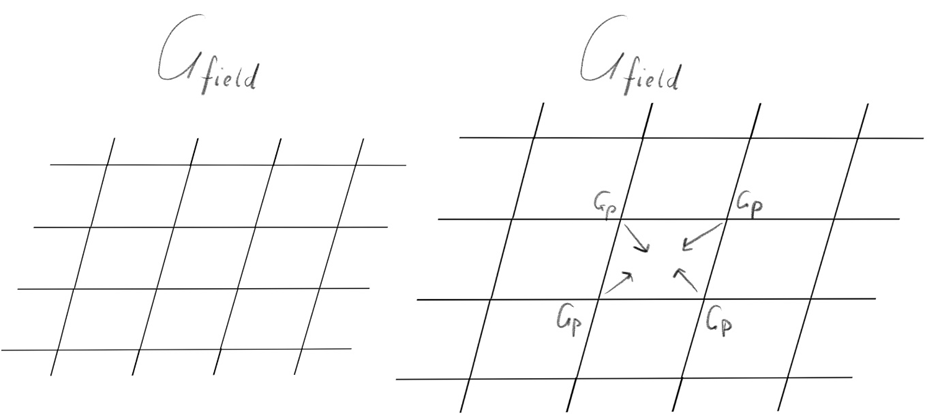
The left image is the neutral state of the Gravitational field. This state has no exertion at all. It is basically the same thing as a spring under no tension.
The right shows the same field in the presence of mass. The field has expanded, it has been pushed outwards, but it’s trying to get back to its original position, creating this pressure. This is the same as a stretched spring.
Another way to picture the pressure (because it’s obvious by now that I like to show way too much, just in case I’m not getting my point across – Sorry) is as follows:
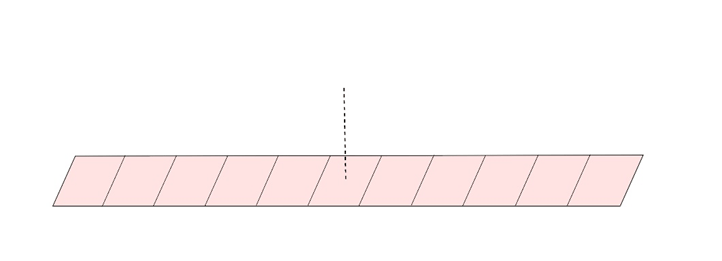
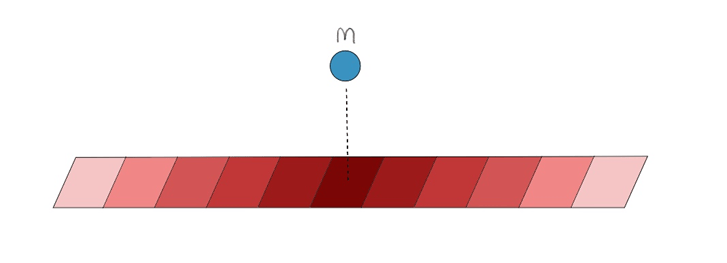
Pretty self-explanatory. The presence of mass increases the pressure. The pressure peak is at the point of mass.
Back to the main show.
Orbiting mechanics:
There are a couple of ways we can picture the effects of gravitation.
The first is the image below, as we’ve been using in previous chapters.
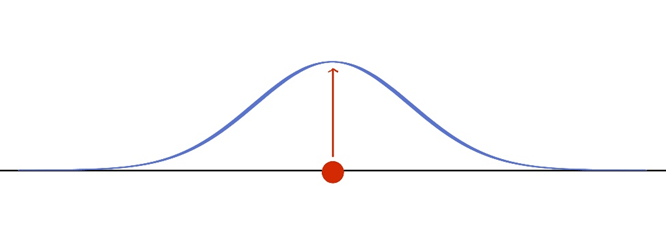
The line is the gravitational field being stretched, the area underneath would be the pressure force of the field trying to return to normal. (think back to Figure 4).
A different way to picture it is below. A point mass in the centre with gravitational pressure expressed outwards like so:
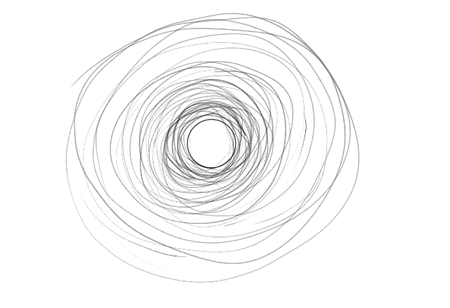
The circles/rings/spirals represent the strength of the pressure. (tighter rings the closer in and more spaced out the further out.) If we use Figure 4 again you’d see dark red at the centre, slowly decaying to the light pinkish colour as you move further out.
There’s also a third way to show it, it’s kind of a mix of both above images, with “Gravitational Field Lines” expressed in one direction like so:
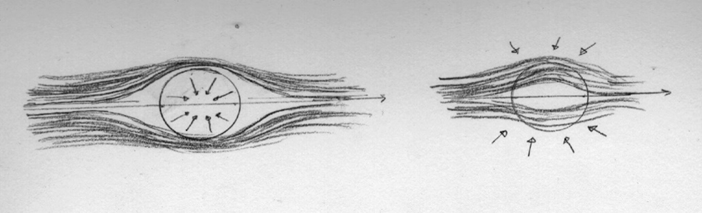
The idea here is to express the field “Warping” around an object in that plane. The field lines compressing together and their combined Elastic force trying to push back. I still don’t know if this is a good way to picture it, but it helps show how this affects other aspects of the idea.
Two Bodies:
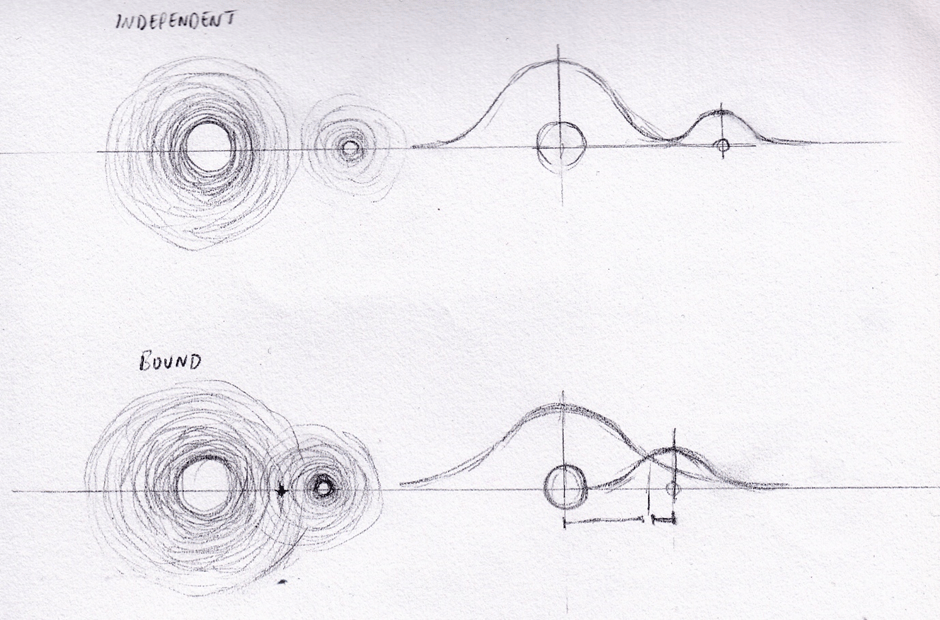
This basically shows different ways to express the gravitational pressure. Using the directional plane can also express it in an orbiting frame like so:
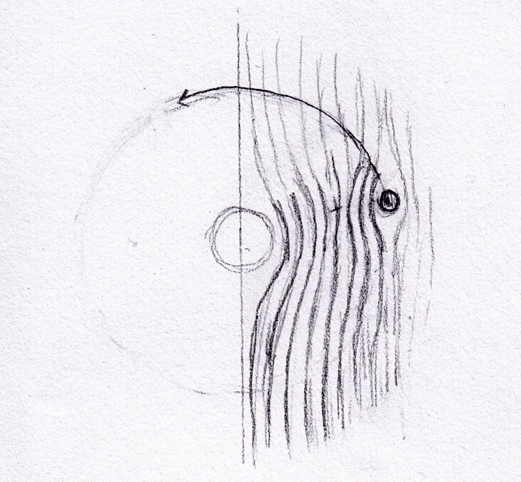
Without orbiting mechanics the masses would be drawn together in a straight line. But if we add motion to the smaller mass (and use the Gravitational Field Plane to see its effects) we get the above.
Showing the vectors of all the “forces” acting on the smaller mass we get the following below:
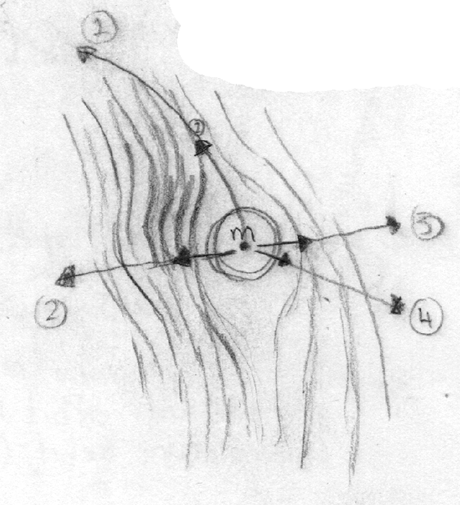
The gravitational field lines are running vertically. These lines are being “pushed” away from the two masses. This results in gravitational pressure around the masses that decreases with distance. The secondary mass, kind of “catches” between the warped field lines caused by the main mass, further warping said field. These altered field lines produce a strange pattern, no longer neatly stretched, but instead pushed and pulled between the two bodies, trying to find its way back to its neutral state.
And because the smaller body is orbiting, that field distortion is being drawn along with it, creating a slightly greater pressure ahead and a lesser pressure behind. Reality is, this difference would be so tiny, as the orbiting velocity of the smaller mass is too slow, just like a tennis ball’s mass is so small compared to the planet. And just like the ball’s mass can be ignored, this slight pressure difference can also be ignored.
But there is still a pressure caused by that difference and that will be far more important in coming chapters.
Back to Figure 9 and all the vectors involved.
(Side note: This picture is slightly wrong. Vector 1.) V(1) should be a straight line, moving at right angles to the Gravitational Pressure Vector. The V(1) I’ve listed is the resulting vector of its orbital direction after all the vectors are taken into account. So let’s pretend it’s straight)
Each vector is a force acting on the mass. V(1) is the velocity direction (ok, that’s not a force, but you know what I mean). V(2) is the total pressure from outside the smaller mass, pushing the body towards the central mass (as we discussed from Chapter Two). V(3) is the counter pressure, pushing outwards, from the balancing point at the Lagrange point. And, V(4) is the built-up gravitational pressure caused by the orbiting mass.
Adding these all together so that forces either cancel out or combine together, we get the overall directional vector of the smaller mass, Figure 8. This results in the smaller mass orbiting the larger. The smaller mass needs to be travelling at a specific velocity at that specific distance to remain in orbit.
Some questions I’ve yet to work out/expand on:
Does this work for Mercury’s strange orbit?
What effect does the leading gravitational pressure edge have?
If the velocity is fast enough, would that leading edge cause some issues?
Does this leading edge have an impact closer to the larger mass?

