So, let’s begin with the basics.
Apologies in advance for all my terrible graphs and images. I’ve converted several to digital, but I’m lazy so many will be hand drawn.
Basically, there is a field all around us. It permeates all of space. At any time we’re subject to this field. But just like a +ve and -ve charge it is repelled in the presence of matter. This repulsion causes the field to stretch, and thus in turn, creates a potential energy within the distortion.
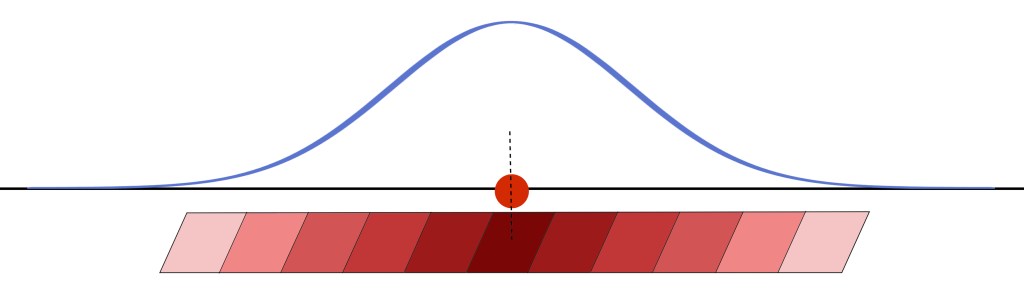
Looking at the image below: the straight line is the neutral state of the field in the horizontal plane. And the curved line is the new path. The red dot in the middle is the mass causing the distortion.
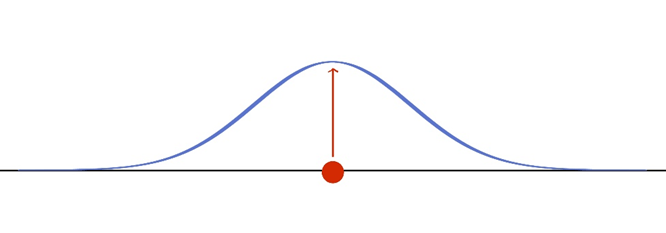
The field doesn’t like being on this new path, it’s trying to get back to its original state, exerting pressure downwards, like so:
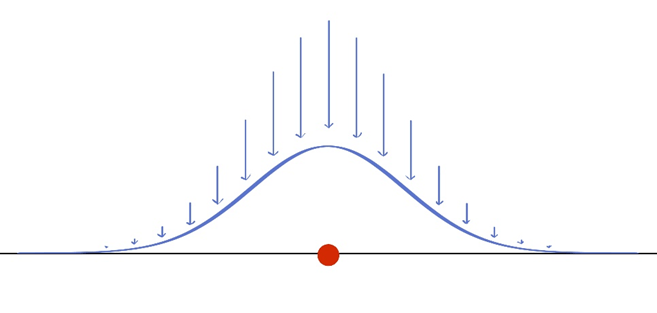
The further the field is distorted from its original path the more pressure it exerts trying to return to its neutral state.
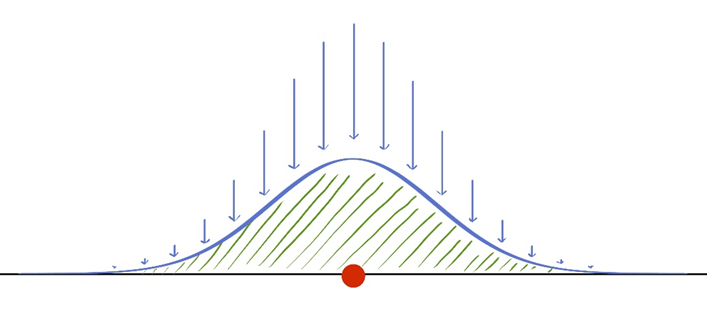
So our theoretical red mass point in the middle has a lot of potential energy bearing down on it.
Now, the thing is, we’re just picturing this in one direction. With one field line going left/right. But it would be happening in every direction simultaneously, 360° all around. So if we just copy this terrible image and flip it around a few times we see a pattern emerge.
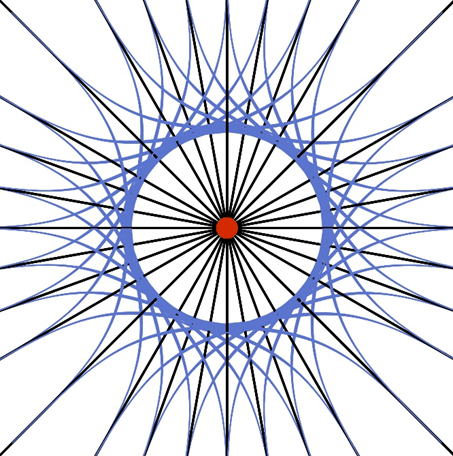
Not the best representation but my drawing program wasn’t happy with me copying, pasting and moving the same image several times. (even if it did it’ll still look rubbish, but you get the idea)
The more times you copy and flip the image the more pronounced the sphere becomes, and will develop further and further out. Stronger closer to the mass, fainter the further out.
So, basically, what we have is the Gravitational Field behaving like Space-time in General Relativity. When in the presence of mass it streatches from it’s initial “ground state”, and a resulting pressure acts like a compressing force as a result.
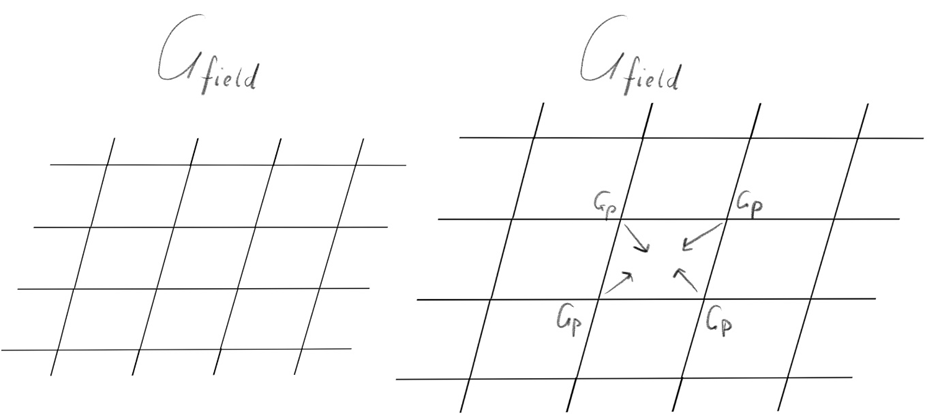
The left image is the neutral state of the Gravitational field. This state has no exertion at all. It is basically the same thing as a spring under no tension.
The right shows the same field in the presence of mass. The field has expanded, it has been pushed outwards, but it’s trying to get back to its original position, creating this pressure. This is the same as a stretched spring.
Another way to picture the pressure (because it’s obvious by now that I like to show way too much, just in case I’m not getting my point across – Sorry) is as follows:
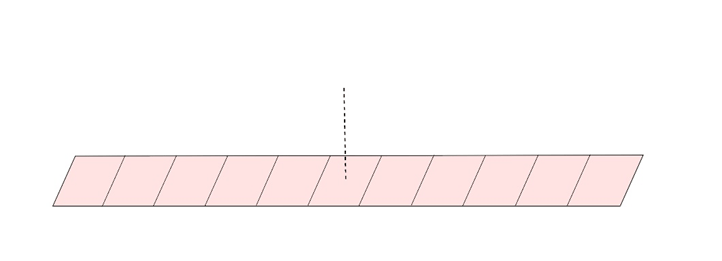
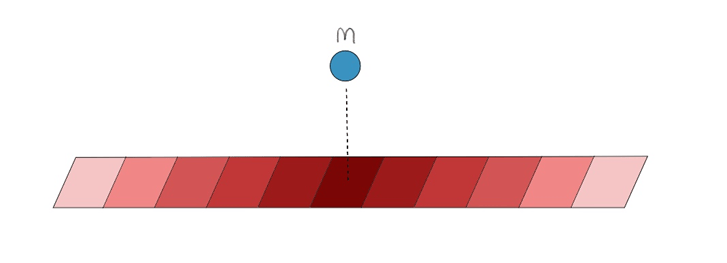
Pretty self-explanatory. The presence of mass increases the pressure. The pressure peak is at the point of mass. (I’m just trying to give as many ways to picture gravitational Pressure. Might evolve as time goes on.)
The Gravitational Constant:
So, I’m gonna to on tangent for a little bit, and propose a question.
And that question is. What exactly is the Gravitational Constant? I don’t think anyone has ever explained exactly what it is. And I couldn’t find anything on the internet. People say, it’s just a constant. But constants come from somewhere, they mean something.
If we look at the units:
The Gravitational Constant is 6.67×10⁻¹¹ N.m2/kg2
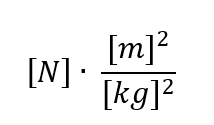
With N being the Newton which is a unit for force. It means the amount of force required to shift a one kilo object one meter per a second squared. (per a second square is acceleration).
If we switch the N with its fundamental units we can expand G to:
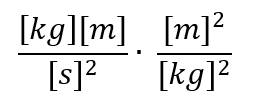
If you’re not aware about units this is the same as what we just had, it’s just expanded out. The N really, just makes things look neater. We can then add them together or cancel them out to give us the most basic units:
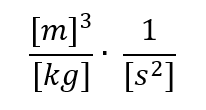
Now our reimaged units are: meters^3 per kilogram and per sec^2.
So now we’ve broken the units down again. What are these units? Well, the second is easy. It’s just acceleration, taken from the Newtonian part. The first part though is interesting. These are the units for density, but reversed. Applying the acceleration turns this into a unit denoting a force. So basically this looks like anti-pressure in 3 dimensional space.
What on earth is anti-pressure? Is that even possible?
I guess instead of a force pushing outwards, it’s a force that draws inwards. From a warped space perspective it just looks like normal pressure.
But if that’s the case, why would space exert this inward-pressure at all?
Well, if the gravitational field lines are stretched then it’s a given they’d rather be un-streched (yes that’s a technical term) – and given every reaction has an equal and opposite reaction, that would suggest there is an opposing force trying to stop that stretching in the first place. Pushing downwards, the gravitational field is exerting pressure in the normal sense of the word. This would appear like anti-pressure from our perspective, but is like normal pressure from the gravitational field perspective.
So while the field is being stretched out, the inward “anti-pressure” is trying to bring it back in … and that’s what I think G is. It’s the elasticity of space trying to return to normal.
Review
The Gravitational Field is warped in the presence of Mass
The Gravitational Field tries to return to its neutral state, causing a Gravitational Pressure on the mass within.
Gravitational Constant could be connected to this Gravitational Pressure.

