Okay, so we’ve seen how mass can work on a large, astronomical scale. But how does how does that look on Earth with smaller objects?
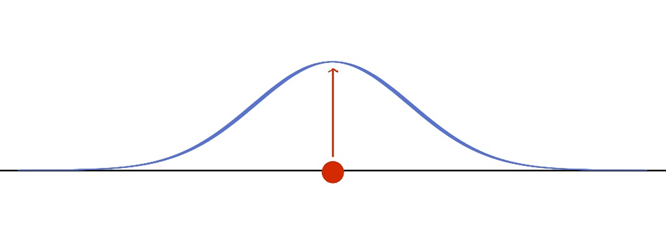
Just like in the planet-sun example earlier, the Gravitational Field warps around all mass. Not just massive bodies like planets and stars. But all matter, from the largest Black Hole to the tiniest dust mote. Everything.
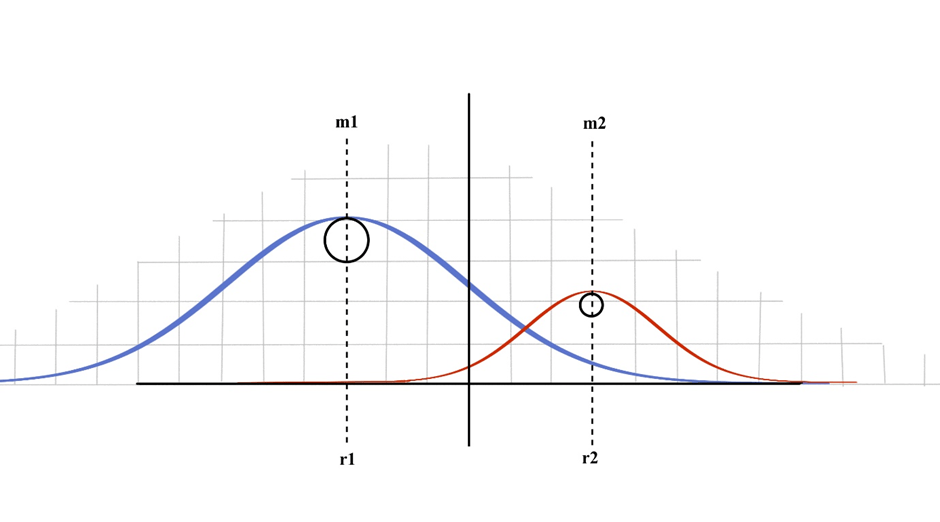
And, when you have two or more masses within reach then they will be drawn to each other. Just like our star-planet example, and this also applies to everything. The only difference is that unlike the examples above (And in previous chapters) the Primary mass is so dominant that we can effectively ignore the contribution of the smaller mass altogether.
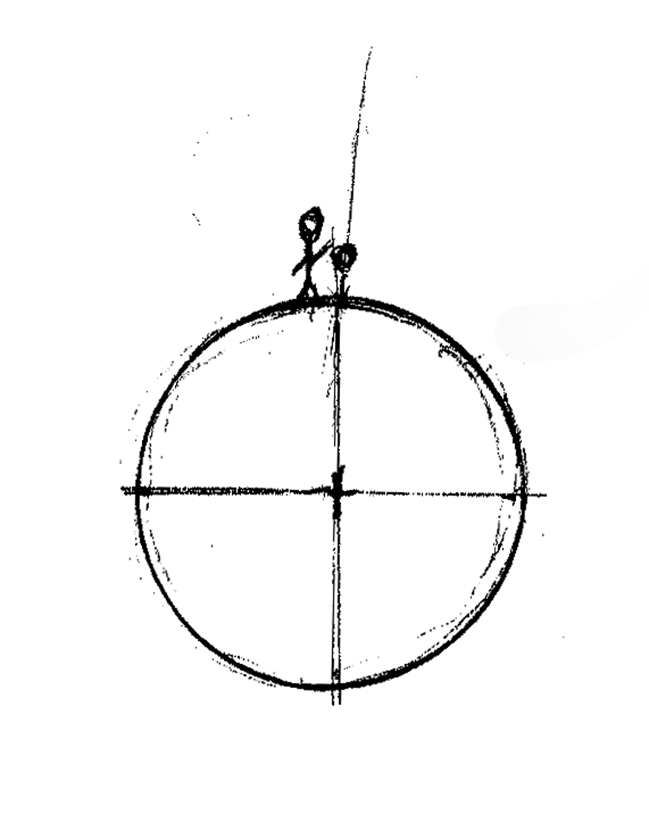
This ridiculous, flat-earther triggering, overly exaggerated image shows a non-descript stick figure dropping a ball. Said ball falls to the Earth for the exact same reason why the two bodies in the previous chapter are drawn to each other. Because the line of sight between the two bodies cancels out the effect of gravitational pressure beyond the Lagrange/neutral point between the two masses.
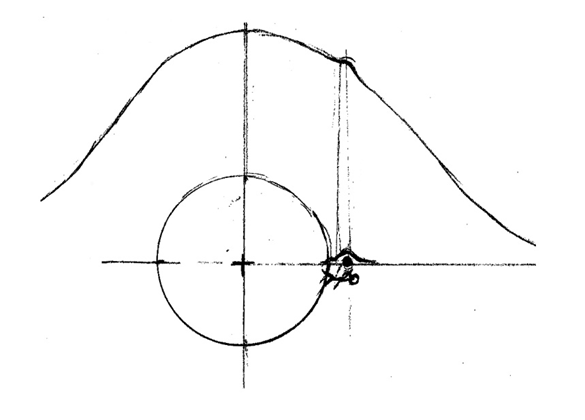
If we apply our gravitational field distortion to the ball and the planet — and rotate our cartoonishly-small world around — then we get our familiar picture (ignoring the unco, skewered bellcurve) And just like before, their distortions are accumulative.
The difference is (when we picture this on proper scales), the ball is SO SMALL and the planet SO BIG, that the ball’s contribution to the Gravitational Field’s distortion barely makes a difference and the point where the two gravitational pressures are equal is so close to the centre of the ball that it my-as-well be the centre. So we can ignore the small body’s mass.
The most important information in this scenario is that the line of sight still exists. And as such we still have both bodies drawn to each other.
You might struggle to imagine this (as I did) – it seems that the cancelling out pressure between the two objects would cause the larger mass to hurtle towards the ball at a pace as dramatic as the ball falling to the planet. But that’s not accounting for the sheer size of the larger object.
Two things I’d like to point out:
First, When you compare two masses you get both: the Lagrange point (L1), and the centre of mass (CoM).
L1; as stated, is the point where the gravitational pressure that draws things to each body cancels out, and is basically at the centre of the ball.
But the centre of mass is the point where two falling objects would eventually meet. So in the scenario of a ball falling to the planet, the centre of mass will be so close to the centre of the planet that there is no discernible shift.
Second, The mass area of the Planet is so huge, that the gravitational pressure lines are almost parallel with the ball’s line of sight. That gravitational pressure outside the ball’s influence is still bearing down on the planet without interruption. The small, gravitational blip caused by such a tiny area (from the ball) seems insignificant from the point of view of the planet. And that’s the important factor. The sphere of influence of the smaller mass is minuscule compared to the surface area of the larger mass.
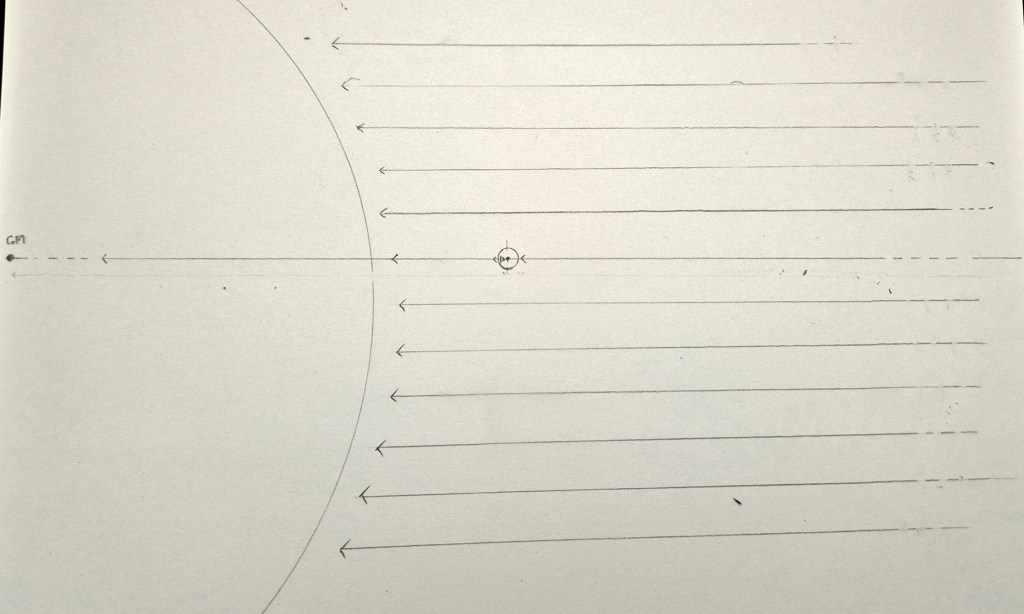

So, a simple recap we have:
The entire, overwhelming force of the gravitational pressure bearing down on an ~8cm ball.
And though the planet does get pushed towards the ball as well. Its movement is minuscule in comparison, to the point it can be ignored.
The combined centre of mass of the two masses would be the point at which both masses would meet. (if there wasn’t an annoying thing, like the ground, in the way).

