Okay, so we have established that a mass will stretch the gravitational field, Changing the gravitational density and exerting an “anti-pressure” on said mass.
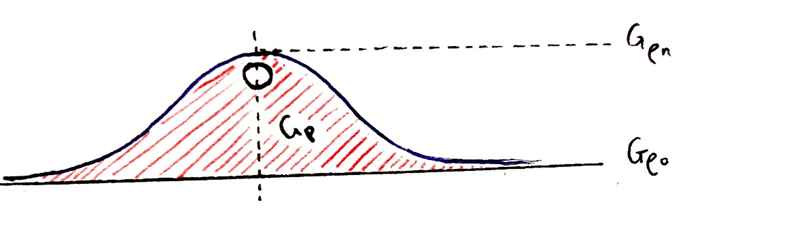
Gρn should be Gpn which is the stretched Gravitational Pressure.
Gρ0 should be Gp0 and is the neutral state of Gravitational Pressure.
And Gp would be the Gravitational Energy.
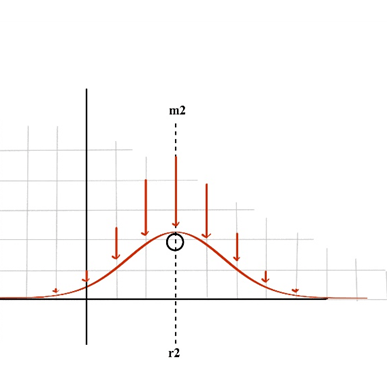
So let’s try and picture what this gravitational pressure would look like.
The gravitational pressure “felt” by the mass will be even from all directions. If we look at our image we see that the pressure from the left side of the mass will equal the pressure from the right side. They are perfectly even.
But, what happens when we introduce a second mass?
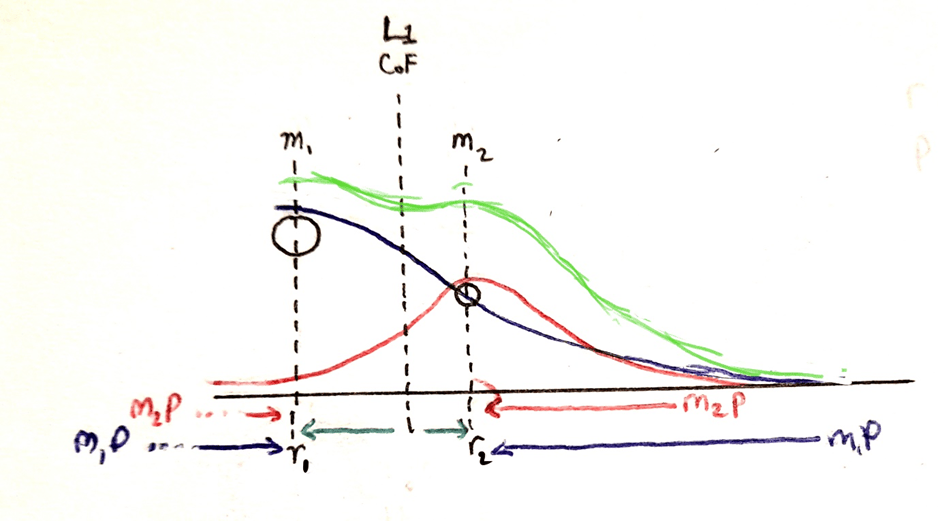
If we have two masses then the Gf (gravitational field) will stretch from both, with both influencing the space around them.
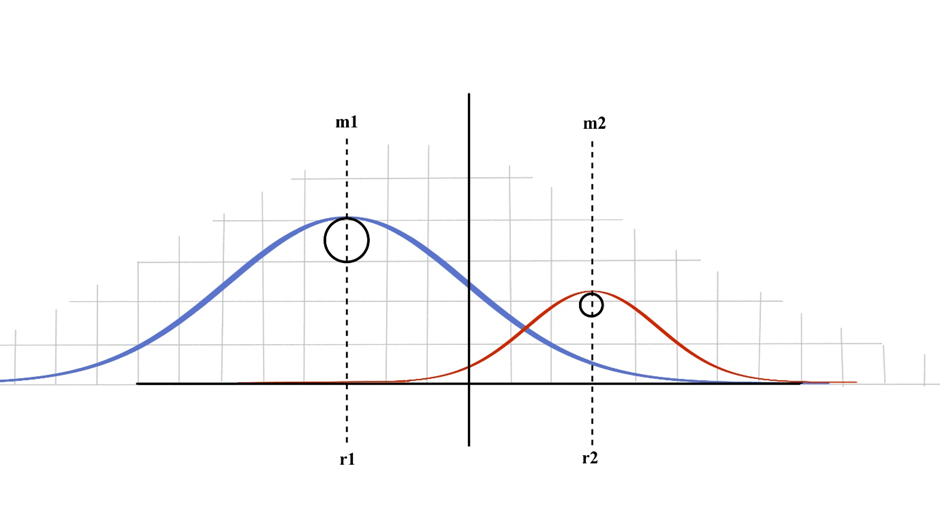
If these masses are by themselves then the field would be even on all sides for that mass. (blue for the larger mass, red for the smaller). The subsequent pressure would keep everything within the centre like we discussed in Chapter 1.
But if both these masses overlap then the resulting gravitational field will warp around both. Combining the Gravitational Field Distortions of both to produce a new shape. which is what we expect with gravity. It’s accumulative.
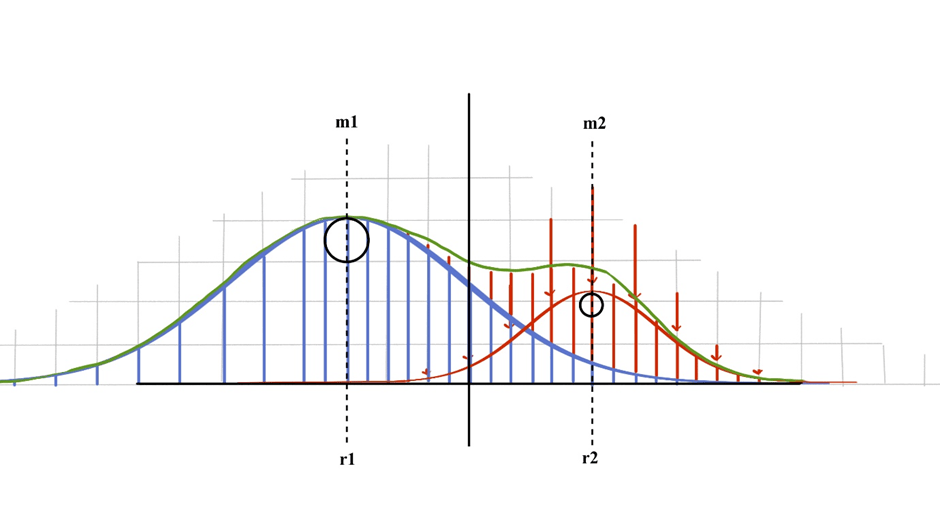
Having more than one body changes the entire dynamics of gravitational pressure in the system.
The smaller mass (we’ll pretend that it’s a sun/planet system, even though the image I drew would be more representative of a larger and smaller star (for a planet the second mass would be MUCH smaller)) is now caught in the Sun’s sphere of influence (the area around the planet has significantly stretched from what it would be like if the smaller mass was alone). But it isn’t completely dominated by the larger mass, it still has its own region. Like an island within the larger system. The larger the small mass is the larger that island would be, and the smaller it is, the smaller that island.
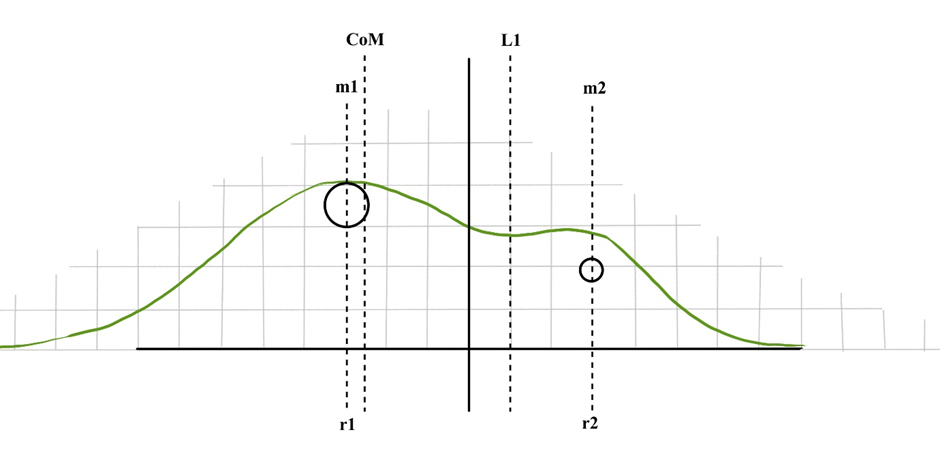
Returning to the graph images. We no longer have a nice, clean bell curve for the stretched space. It is unbalanced. The pressures on either side of both masses will no longer be equal. And this will affect both masses.
The new curve also shows us two things. It shows the smallest shift of the Centre of Mass. But what is this centre of mass? It is the point of the greatest gravitational density. This is the peak, the point in which the entire system now revolves around.
And the second is the small dip between both bodies near the smaller mass. This is the spot where the gravitational pressure between the two masses is equal. Anything sitting here would feel equal pull towards both masses and therefore wouldn’t be drawn to either … This is called the first Lagrange Point.
Now here’s the interesting thing. In three-dimensional space, anything floating around will be subjected to both masses. Even when that object is well in the sphere of influence of the smaller mass, the pull from the greater mass will still be felt. Even well outside the smaller masses influence, the object would have the faintest of interactions with that smaller mass.
This applies everywhere EXCEPT in direct line between both bodies. On a one-dimensional line, the influence is determined by which side of the Lagrange point the body sits.
So here’s a picture for both bodies and the resulting Gp felt by them.
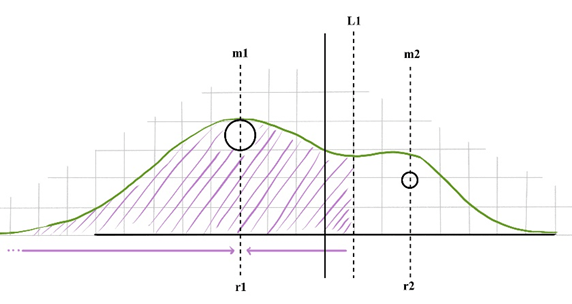
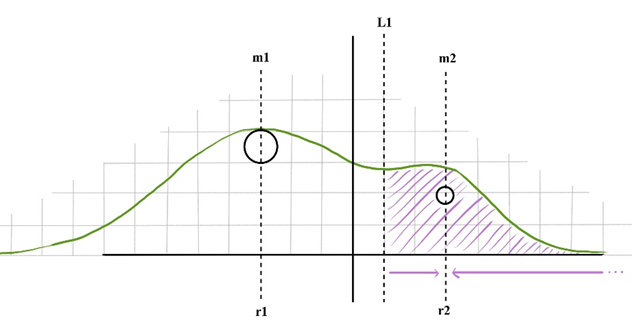
Another interesting consequence of this quirk is that both bodies are now cut off from part of their normal gravitational pressure on one side. What once was even and keeping everything firmly in the middle, now has a greater pressure pushing on the outside of the system compared to the side with the secondary body.
This results in both bodies being drawn towards each other. Just like in Newtonian Gravity.
Now my maths isn’t great. I can’t derive formulas for the life of me. But I can express the systems in pressure and distance.
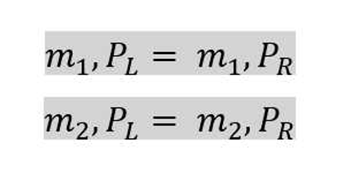
m1 is the mass of the larger body and m2 is the smaller mass. PL is the pressure on the left side, and PR is the pressure on the right side. Putting them together we get our mass/pressure relationship. By themselves both sides are equal.
Adding both separate formulas together we can calculate the new pressure experienced by their combined influence for either side (with the large mass being the point of reference).
Left side of Mass 1:

Right side of Mass 1:

This now shows the total gravitational pressure of the combined system relative to the Main Mass.
We can also show the new total pressure experience by either body (the purple filled area in figures 2 and 3), Where Lr is the Lagrange point position:
Total Gp experienced by Mass 1:

Total Gp experienced by Mass 2:

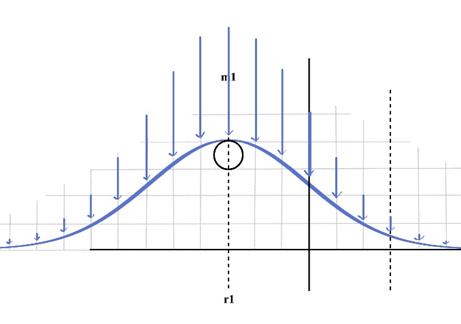
So coming back to the two body image we can now apply the direction of pressure. Shown with the little arrows below.
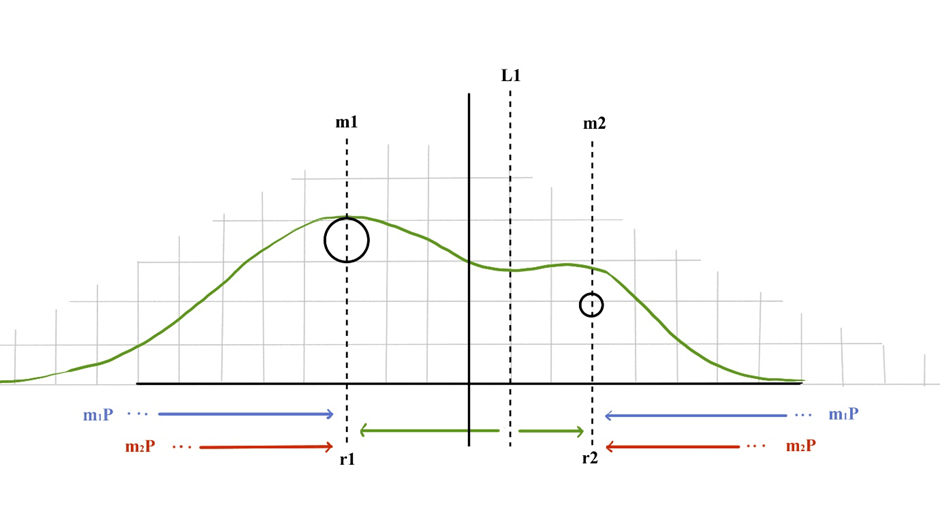
As you can see the combined pressure on the left side of M1 (the blue and red Pressure lines) are now much greater than the pressure it experiences on the right side (The green line – remember, we only count the pressure from the Lagrange point to the mass)
We can also see that Gravitational pressure on the inside (Green line) of the smaller mass is much smaller again, compared to the force pushing from the other side. So that would result in much more pressure on the outside, exerting a greater force against the smaller mass compared to the larger. The further away the masses are, the smaller the imbalance of pressure felt by either.
This effect only applies when the two bodies are directly in line. If we look from a different angle, the combined pressures still apply, but there is no cancelling affect. Their masses are simply seen as one.
So, for example. We’ve been assuming these bodies are orbiting. Like two suns, or one sun and one planet. If the bodies weren’t orbiting and they were just sitting it space, they would “fall” towards each other.
The smaller body would move at a greater rate as it has a much lower inner pressure to counter the combined outer pressure.
The larger mass is also, still unbalanced, with the inner pressure from the Lagrange point to the mass still being smaller than the combined outer pressure. It might have less of an imbalance than the smaller mass, but it’s still imbalanced. So the outer pressure wins as well, pushing it towards the smaller mass.
The difference in imbalance means that the smaller mass is being pushed inwards at a greater rate than the larger one.

