There are three ways I like to picture the effects of gravitation.
The first is the image below, as we’ve been using in previous chapters.
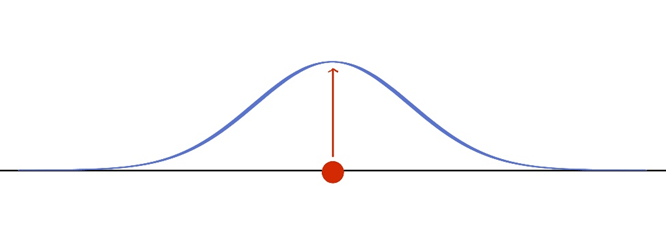
The line is the gravitational field being stretched, the area underneath would be the pressure force of the field trying to return to normal. (think back to Figure 4).
A different way to picture it is below. A point mass in the centre with gravitational pressure expressed outwards like so:
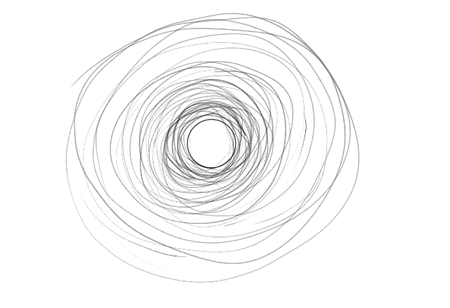
The circles/rings/spirals represent the strength of the pressure. (tighter rings closer in that become more spaced out with distance, until eventually, it returns close to the neutral position).
The third way to show it is kind of a mix of both above images, with “Gravitational Field Lines” expressed in one direction like so:
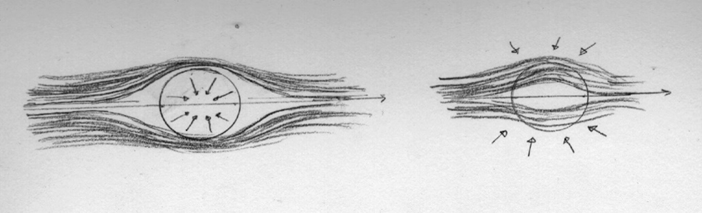
The idea here is to express the field “Warping” around an object in that plane. The field lines compressing together and their combined Elastic force trying to push back. I still don’t know if this is a good way to picture it, but it helps show how this affects other aspects of the idea.
Two Bodies:
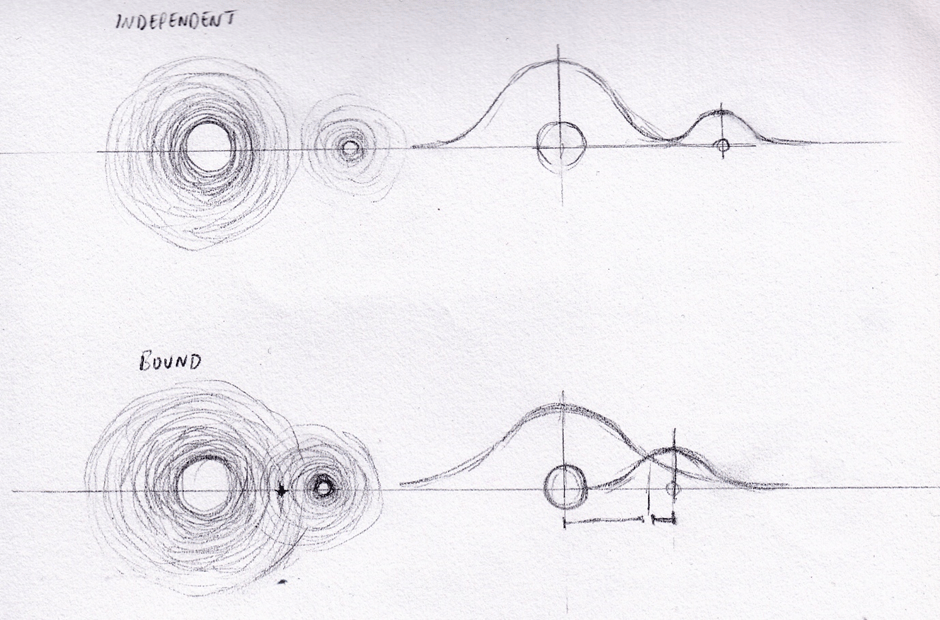
The Bottom shows the masses closer together. They are now bound and will be drawn together.
This basically shows different ways to express the gravitational pressure. Using the directional plane we can also express it in an orbiting frame like so:
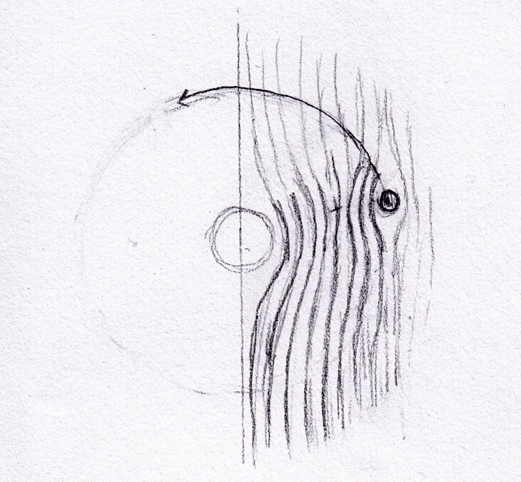
Without orbiting mechanics the masses would be drawn together in a straight line. But if we add motion to the smaller mass (and use the Gravitational Field Plane to see its effects) we get the above.
If we consider the motion/force vectors acting on the smaller mass we get the following:
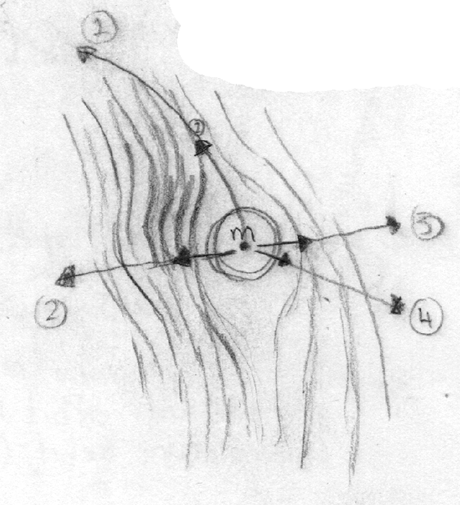
The gravitational field lines are running vertically. These lines are being “pushed” away from the two masses. This results in gravitational pressure around the masses that decreases with distance. The secondary mass, kind of “catches” between the warped field lines caused by the main mass, further warping said field. These altered field lines produce a strange pattern, no longer neatly stretched, but instead pushed and pulled between the two bodies, trying to find its way back to its neutral state.
And because the smaller body is orbiting, that field distortion is being drawn along with it, creating a slightly greater pressure ahead and a lesser pressure behind. Reality is, this difference would be so tiny, as the orbiting velocity of the smaller mass is too slow, just like a tennis ball’s mass is so small compared to the planet. And just like the ball’s mass can be ignored, this slight pressure difference can also be ignored.
But there is still a pressure caused by that difference and that will be far more important in coming chapters.
Back to Figure 5 and all the vectors involved.
(Side note: This picture is slightly wrong. Vector 1.) V(1) should be a straight line, moving at right angles to the Gravitational Pressure Vector. The V(1) I’ve listed is the resulting vector of its orbital direction after all the vectors are taken into account. So let’s pretend it’s straight)
Each vector is a force acting on the mass. V(1) is the velocity direction (ok, that’s not a force, but you know what I mean). V(2) is the total pressure from outside the smaller mass, pushing the body towards the central mass (as we discussed from Chapter Two). V(3) is the counter pressure, pushing outwards, from the balancing point at the Lagrange point. And, V(4) is the built-up gravitational pressure caused by the orbiting mass.
Adding these all together so that forces either cancel out or combine together, we get the overall directional vector of the smaller mass, Figure 4. This results in the smaller mass orbiting the larger. The smaller mass needs to be travelling at a specific velocity at that specific distance to remain in orbit.
Review
Gravitational Pressure draws objects of mass towards each other
To avoid coming together Mass needs to be moving relative to each other.
Movement at the right speed with enable orbit.
Some questions I’ve yet to work out/expand on:
Does this work for Mercury’s strange orbit?
What effect does the leading gravitational pressure edge have?
If the velocity is fast enough, would that leading edge cause some issues?
Does this leading edge have an impact closer to the larger mass?

