Note: this Page is out of date. It contains my earlier attempt and has some ideas I have since dropped and/or changed. Links provided can direct you to the chapters (or follow the menu links)
Chapter 00 – Hypothesis
Chapter 01 – The Basics
Chapter 02 – Two Body System
Chapter 03 – Throwing a Ball
Chapter 04- Orbiting Bodies
Chapter 05 – Bringing Special Relativity into the Fold
Chapter 06 – General Relativity: Does it Stand Up?
Chapter 07: The Move to Quantum – Discovering the Casimir Effect
MY QUESTIONABLE THEORY OF ALTERNATIVE GRAVITATION – a WIP
Let it be known: This is my thought theory. It could be absolutely and painfully so far off base that I’ll be laughed at for all eternity, (let’s be honest, that’s far too optimistic, I’d just be ignored like all the other nutters.) Anyway, I have no idea how to approach the mathematical side of things so this is merely an exercise of the imagination… This has been an evolving concept since ~2016/18 with much moving backwards and forwards, bursts of inspiration followed by ‘What was I thinking?’ and a completely haphazard attempt to organise it coherently – Signed Me, 13/May/2022
Last updated 03/FEB/2024
Hypothesis:
1.) Gravitation is simply a consequence of matter within a field: which I call the gravitational density field (Gρ)
2.) Gρ is bound by the conservation of energy law, much like momentum.
3.) The gravitational field exists in a ground state that is distorted in the presence of matter. As such it exerts pressure on matter in an attempt to return to the field’s ground state (GP).
4.) The electromagnetic field arises from vibrations within the GDF. A photon is a resonance or localised vibration moving along the field-line.
Intro:
You might say what I just described is Albert Einstein’s curvature of space-time. And you’d be right. But I feel this could possibly explain why space moves around matter, and possibly some other ideas can be born from that. Bear with me, because I think there could be some merit, at least in imagining the universe around us.
Matter isn’t attracted to matter. It does not produce a gravitational field drawing two bodies together. Instead, a Gravitational Density Field permeates all of space in all directions and the presence of Matter within it distorts it. (One can view this as either the field being stretched [general relativity] or being compressed – I usually think in one or both ways to conceptualise the consequences of their interaction) but ultimately the density of the field increases in the presence of matter.
Matter warps the field, it pushes it away from itself, but the field wants to return to its natural, unstretched state, so it pushes back, exerting gravitational pressure. And this is what draws bodies toward each other.
Questions I’m not sure of:
1.) Does bunching up/stretching the field cause it to act like an elastic spring, and therefore does it have a threshold/limit?
2.) Does mass affect it in other ways? Is the GDF variable?
Gravitational Field Density and Pressure:
I firmly believe that the Gravitational Constant either is or is somehow part of the Gravitational Field Density Gρ, and that it’s possibly not a constant at all, but either a subtle variable, or a field that has been slowly decaying as time goes on.
Currently, we have issues with dark matter, the universe’s expansion rate and missing mass. If I am correct and Gravitational Density is a variable (the Gravitational constant) it could account for all these things.
Seeing the Gravitational Constant as a decaying/variable Gρ could help explain:
- Missing mass in galaxies
- Rapid inflation of the early universe
- The accelerating expansion of the universe
The Gravitational Constant is 6.67×10⁻¹¹ N.m2/kg2
Breaking down its units we get (m3/km)s2.
That is the inverted units for pressure in 3D space. This would suggest it is an anti-pressure. But what if it’s evidence of conservation of momentum? For a system to be conserved, then a balancing force must be exerted on us – thus this inverted pressure is actually the potential energy and is pushing down on us, thus gravity.
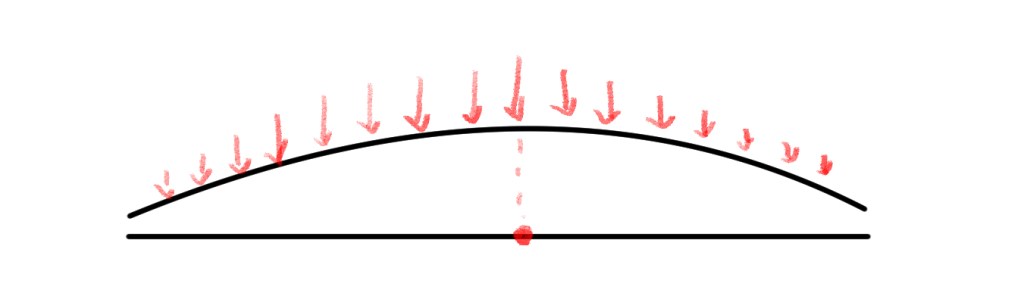
The more the gravitational field is distorted by matter then the more Gp is exerted on that same matter.
This could affect our universe in one and/or two ways:
- A stronger gravitational density early in the universe that steadily decayed over time and will continue to slowly decay as the universe ages.
- A variable gravitational density in relation to mass.
Gravitational Density Field Decays Over Time:
Much like how space is expanding, so too does the field with it (perhaps they are part of the same thing) and that means over time the density decreases.
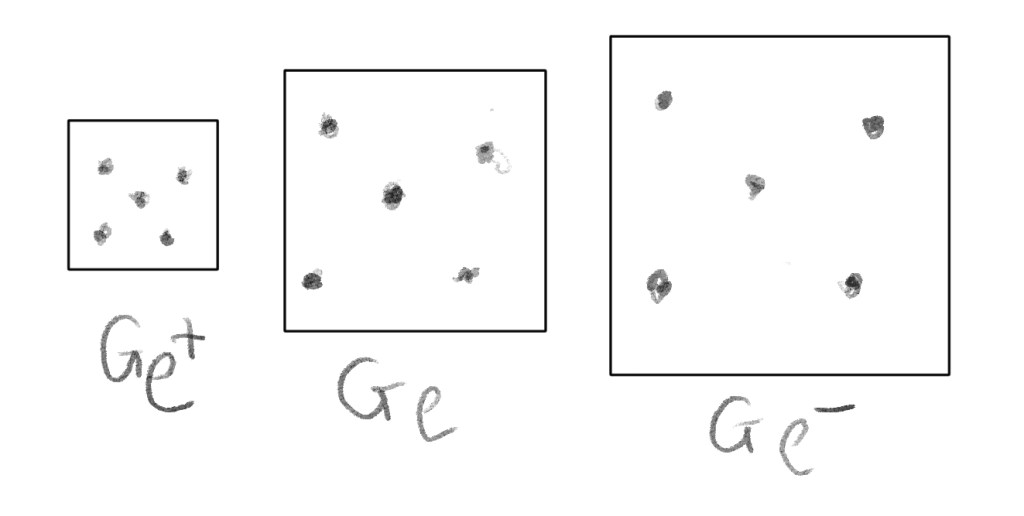
This could affect our universe in one and/or two ways:
This means Gρ would have been much stronger than it is today. The clumping of matter would’ve been more efficient: allowing stars and galaxies to form more rapidly and possibly earlier. Early stars built from the foundations of the BB could’ve been denser than once thought, and burned through their fuel faster. This could have also led to an early frenzy of black hole formation. The flip side consequence of this though is that it might also hobble star formation in the future universe. With an increased reliance on heavier elements to trigger star formation.
A galaxy’s forming radius would have been much greater than today. The decaying gravitational density would’ve deprived the outer edges of the stronger forces needed to maintain that star formation, sinking those regions into darkness.
And if the early universe field decayed quickly enough then perhaps the once thriving Star formation regions stopped before more complex systems formed. There is not enough gravitational pressure and/or orbital speed. Leaving the old outer edges too cold and slow to interact. And if these spaces were only active long enough to birth population III stars then all that might remain are the black holes and leftover elements from that brief time. And if the gravitational density was significant enough then perhaps these places are littered with black holes, making up the unseeable matter around us.
Another possible effect is that the Swartzchild radius for the formation of Black holes would also be a variable. So BH formation in the early universe would’ve been easier than it is now. Could a reduced G contribute to the decay of BH?
Possible Issues:
Would objects that formed inside the sphere of influence (SoI) still orbit as that SoI decays over time? – I’m assuming that the gravitational pressure would decrease over time and this would allow star migration.
Expected mass (ignoring Dark Matter) around Galaxies is fairly accurate up to our position in the galaxy (~8kpc) … it’s when we look at the orbital velocities further out that the discrepancy creeps in, if Dark Matter is dominated by cold diffuse gas and blackholes from pop.III stars further out then I’d assume the inner part of our galaxy would have just as much Dark Matter present as well (need to properly study this)
Dark Matter extends to at least 230kpc (the visible side of the galaxy is around 15kpc) – perhaps it’s the sheer scale of the system.
Matter and the Gravitational Field:
The Quantum Scale:
The Gravitational Density Field could be described as a fluid passing around matter. Its displacement from its original state produces density changes around the body of mass, whereas it would be uniform and flat when no mass is involved.

Image: Two expressions on how this could look. If the mass is low then the field would still move through it, but field lines would distort, enacting pressure upon the mass, (ie gravitation).
The Gρ always follows straight lines and permeates through space in all directions. It is deflected by the mass and returns to its original path as it moves along. But the deflection is very small, and field still passes through matter (a point of the field would always pass through the centre of all mass, while anything off centre would deflect/stretch from that point) The more mass involved the greater the effect of the deflection.

on the quantum level, the density barely (if at all) differs from outside its influence. At this level their field of influence is too minute to draw separate particles together, it would need other forces (such as static or chemical bonding?)
If enough particles come together then the Gρ will create a more noticeable deflection, enough so that other stray particles within could find themself drawn into the centre of mass.
The Macro-Verse – Looking like General Relativity:
The Gravitational Density Field (Gρ) is far more pronounced in the Macro Scale than it is on the Quantum Scale. On the small scale, the field and matter react on each other slightly, pushing against each other. There is no clear dominance or reaction; the influence of mass on the field is negligible. But the effect is cumulative, if more matter is added, the field density becomes stronger, it reaches a point where the field’s deflection exerts enough force around the matter that it pushes in on itself, (like anti-pressure) the mass caught within the field wants to push away, but there is nowhere for it to go, as the field exists uniformly all around it.
The more matter added, the stronger the field density becomes and the further out it reaches. With the gravitational density decay following the inverse square law, this means the density of the field stretches further and further out for larger bodies of mass, creating a “Sphere of Influence“.
The overall result is that on the macro scale everything appears just like General Relativity. The more matter involved the greater the deflections.


But Wait, the picture above would actually be reversed! The mass doesn’t cause Space-Time to “sink” like in the popular pictures we see. It causes the density of space to increase, so it’s like space becomes more viscous as we move closer to the body within it.
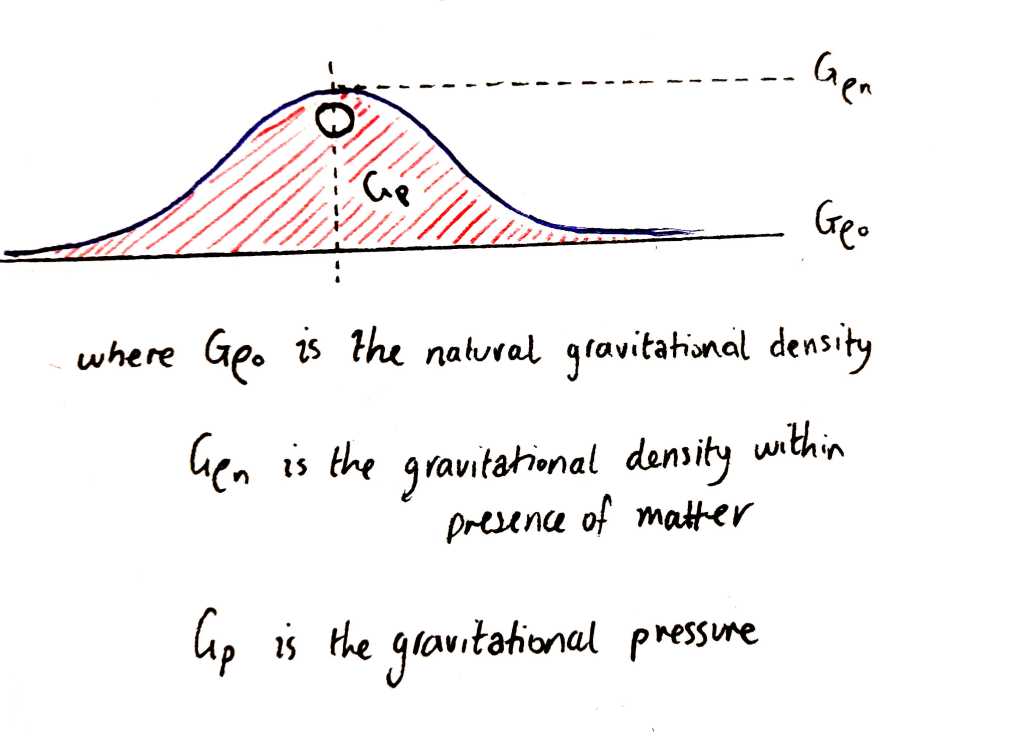
What does this mean? It means that anything moving within the field of influence is subject to a higher Gρ, experiencing the “gravitational pressure” from that body. The closer to the body one moves, the more pressure exerted on the other object, which leads us to:
The Two-Body System:
As we know the Sun’s gravitational pull stretches a hell of a way out. That means the Gρ bunches all the way out there, dropping off at a rate following the inverse square law. Anything inside the Sun’s sphere of influence has its own sphere (including us on Earth) The Earth’s sphere of influence is actually made up of the Sun’s influenced field, as the moon is made up of the Earth’s distortion as well as the Sun’s. Together all objects make a strange kind of Starry Night painting, swirling around each other.
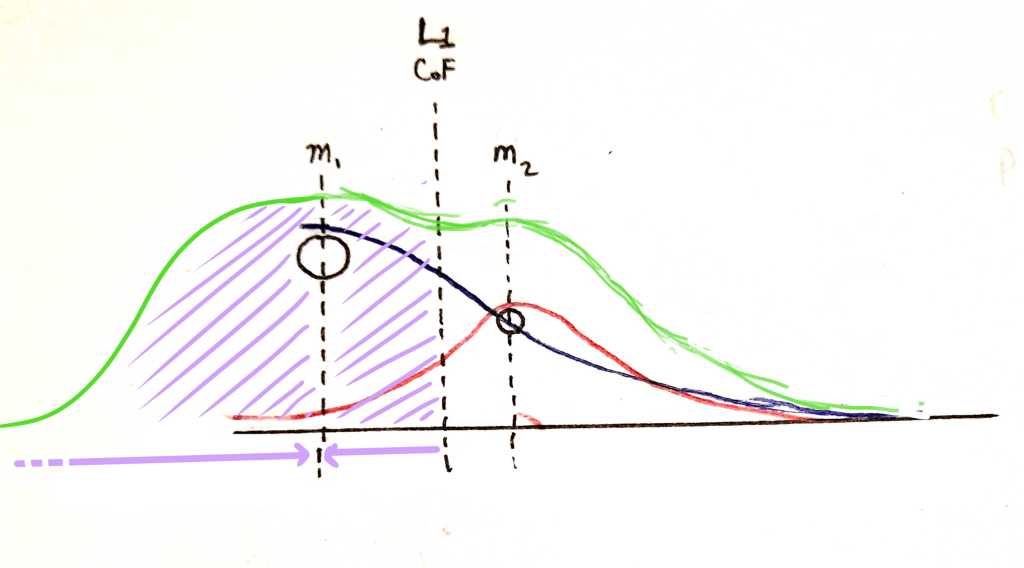
But simply looking at a Two-Body Problem we can actually see why they are “attracted” to each other. Because the overall pressure difference “between” the bodies has a balancing point (This is the Lagrange Point, L1, in orbiting bodies) This balancing point means that the overall pressure between the bodies is uneven, resulting in an ‘imbalance’ that draws them together.
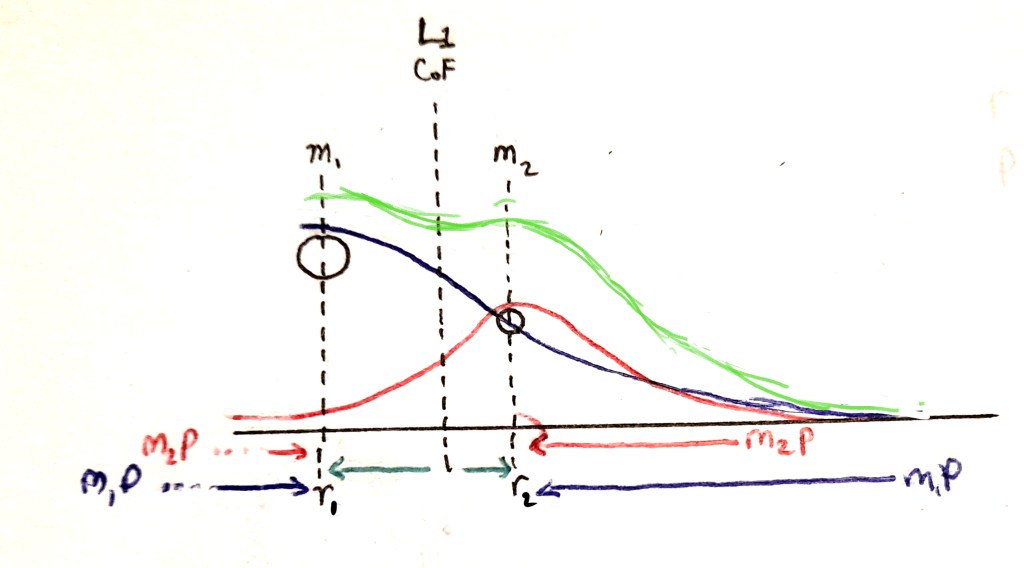
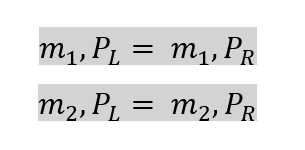
r1 the position of the Mass m1
r2 the position of the Mass m2
Where m1PL is the leftward gravitational pressure caused by Mass m1 and m1PR is the rightward gravitational pressure. Mass m2 follows the same system.
Two Body: Left Side of m1:

Two Body: Right Side of m1:
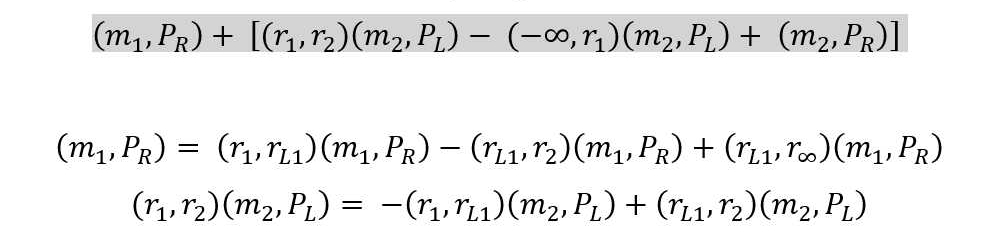
The presence of two masses means that the sphere of influence is interrupted at the Lagrange Point 1 (direct line of sight). So instead of the gravitation density field pushing in equally from both sides, you get each mass only experiencing the pressure up to the L1 point between each other.
Mass 1 total pressure:

Mass 2 total pressure:

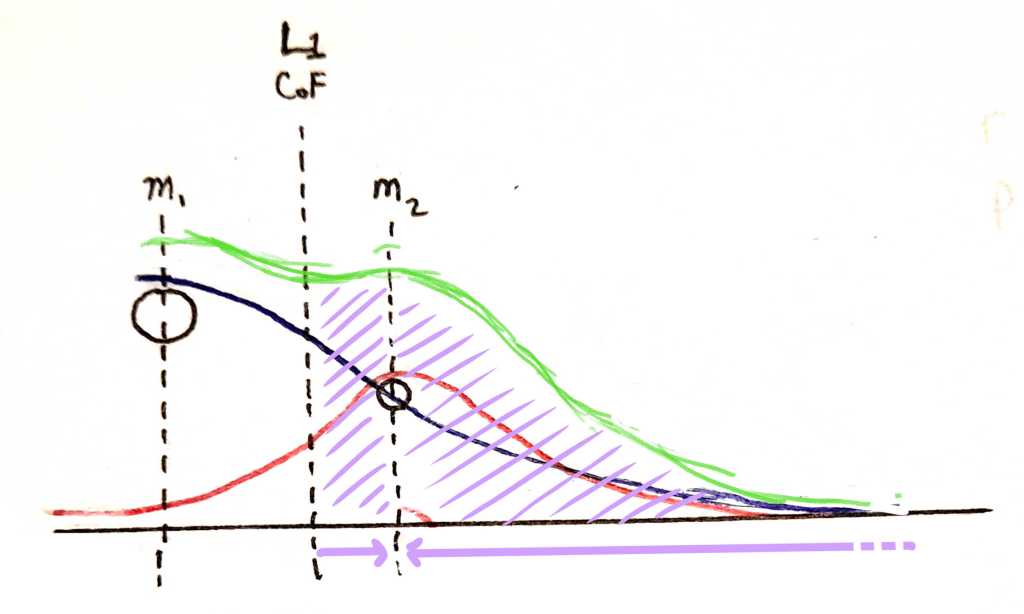
The pressure on either side is now unbalanced and the two bodies are drawn into each other. This is why we fall back to the ground when we jump, and why Orbital Speed comes into play. To keep the small body being overwhelmed by the Sun’s sphere of influence it needs a counterforce to keep it balanced. The orbital velocity + the Gρ pressure between the two bodies equals the inward pressure of the Sun’s Sphere of influence. The closer a body is to the greater mass, the more velocity it needs to counter the increasing density field on the outside of its orbit.


A potential look at how time works: (needs editing, updated pics)
Going back to General Relativity look, we can treat the gravitational field density and time much like momentum, where the conservation of energy is conserved. So as the density increases due to the presence of matter, then time would decrease, aka slow down. A tick of a second would take longer.


Equation: Gd = Delta.t x Delta.d
Light and the Gravitational Field:
Light is the propagation of the GDF. It is like a flick that travels down a rope. It travels at the GDFs limit, the speed of light. Slowly decaying over time as the energy dissipates through the field.
Mass approaching the Speed of Light: (needs heavy editing)
Because the field seems to be limited by the speed of light, its movement is subject to it. Mass moving significantly slower than the speed of light has the field moving around it much faster than the mass is moving inside it, so it can be treated as reacting instantly.
But for mass approaching lightspeed the field reacting around it would become slower and noticeable. It would also react differently depending on which direction the mass is moving relative to it.

Mass at rest would have the field move around it without changing. At lower than relativistic speeds leading edge of movement produces the slightest backward drag force. At relativistic speeds though, depending on the direction, the field will react with the particles movement, stretching much further than inticipated. It could either pass through object almost like it doesn’t exist (moving opposite directions from each other and assuming field line movement can have a vector scale), or the field is dragged along and pulled increasing further away from it’s initial direction, due to the reaction speeds of both objects being closer (a car overtaking another car would require more clear road than a car overtaking a pushbike).
Question to ask for vector field: Would the total sum of all the different directions of the field upon a relativistic particle effect it differently? Would they cancel out? Would it create field drag slowing said particle down?
If my thought theory works then a mass following relativistic speeds would have the density field build-up around it, this would create the relativistic mass we see. The faster the particle is going the greater the vacuum space created by the field, the denser its field of influence and therefore the greater its apparent mass. The particle would need increasing energy to travel faster, as well as maintain its velocity – all particles would experience drag until fell below relativistic speeds. < dang, there goes my spaceship drifting at 0.15c idea.
Mercury and orbital decay: <<< TBA
Odd Thoughts that might or might not be of interest:
Things I haven’t gotten around to or need to be explored further – Some of these might be just rubbish. But I’m not keen to let them go just yet.
A Variable Gρ determined by Space:
This might be a long shot. I’m struggling to think it through. Many issues and unknowns pop up and my limited knowledge keeps running in circles. The gravitational density could be uniform throughout the galaxy and decay slowly over time. But it might also be faintly influenced by the amount of matter around it. If so it would require a lot of matter to make any real difference. If so there might be a slight difference in Gρ in the middle of galaxies compared to the outer edges. The more I think about it the less probable this is. But I want to express the idea just in case some other idea pops up down the line.
Reasoning behind variable Gρ within space frame:
One of our issues around the Gravitational Constant is that we can’t agree on its value. Our instruments have gotten better. And it has narrowed down the value, but it has remained stubbornly elusive. More than that, universities have made multiple measurements and achieved varying results. Instruments can’t seem to agree and the issues don’t seem to stem from the ways in which it is measured.
But if I am right and the constant is a conservation of pressure energy, then that measurement would also be affected by the presence of other bodies. The sun and moon affect our tides. I wonder what these experiments would show if they noted our current distances between these bodies and if the experiments were taken at specific times. Would they finally agree? – Probably not, but I wonder if someone has ruled that out.
Black Holes:
A black hole occurs when the density field is stretched to its limit. The field lines are push so far that they can’t warp back, or hit their limit and snap.
I have two ideas about what goes on inside a black hole.
One is that the field fails beyond the Event Horizon, (EH). It has reached its elastic limit and snaps, leaving a field shadow behind. The direct lines break and fall, meaning there is no field within the event horizon. Meanwhile, the off-centre field lines are pushed away completely, creating the path around the EH where it eventually returns back to normal around the other side (gravitational lensing). This explains why light can’t escape – because there is nothing in there for it to propagate through.
There might not even be an actual singularity involved. Instead mass would either float around (Unable to touch the EH as the field lines create an impassible barrier, the outside pressure is infinite) or the EH field lines pushes everything to gather at the centre. But this might not be the case as there are no field lines within the system, there might not be any exertion except at the horizon. There would be no light in this system. I guess you could call it dark matter. The energy would be stuck in matter form, unable to release in photon form, the only way to transfer energy would be through collisions.
If this model is viable then what happens to the light that enters the BH? If it is just a propagation then is that lost? Energy destroyed? Is it somehow transferred to the field around it? Unlikely, does it turn into a different form of energy once passed into the EH? … question of decay. This is the big flaw in this idea. Perhaps a secondary field is produced within the BH in which the matter inside reacts. Too many unknowns and questions.
The other idea is like General Relativity with the lines dropping to infinity. But I have an issue with light travelling through this, I can’t think of what would stop it from travelling back up the line and out into normal space, except maybe that the downward drop is at light speed, effectively suspending light travelling outwards from progressing. I’m not keen on that idea.
But it does produce an interesting effect for matter within the EH. There would be no spaghettification because the field lines don’t cross every point like in regular space. They are falling to a singularity. Instead of matter falling infinitely down it would become trapped according to its mass size, (essentially objects would exist in energy state levels) the field lines that once pushed all matter into a point is now the very thing keeping it from condensing Further.

There would be layers/rings of mass going down, lighter matter reaching closer to the singularity. The energy coming into the system could break apart that matter, allowing it to move to a lower level. until we reach pure energy that would be like the initial moment of the big bang.

