Okay, so I’ve shared with you my hypothesis. And it seems to explain gravitation quite well, it has also allowed us to reconcile Special Relativity and perhaps Time.
But at the end of the day, that means nothing if it can’t actually … well, work with Relativity. So let’s look at some of the things that General Relativity explains and see if we can get any answers.
Mercury’s Orbit:
Okay, I’m gonna start off with the bummer. Newton’s Laws failed to predict Mercury’s orbit precisely … Basically, Mercury’s orbit shifts ever so slightly with each approach, the shift is so tiny that it doesn’t actually cause a noticeable difference. It takes roughly 100 years for the error to be noticeable on any larger scale. That’s how small it is. Einstein was able to account for this small shift. And bam! Our first confirmation of General Relativity.
Can my idea do that same? … well, if I’m being honest with you. I have no idea. I can’t say yes or no. Because, well, I’m not smart enough to tackle that weird and subtle shift (Again, it’s all in the maths) … Sorry, that’s a dud. Didn’t mean to waste your time.
So, if we can’t explore slight orbital shifts, what else is there?
Gravitational Redshift:
Redshift occurs from more than just objects moving away from each other. There is also a redshift that occurs from moving away from a mass. The Sun’s light is slightly redshifted. The more massive an object, the greater the redshift until we reach Black Holes, where photons fail completely.
My hypothesis works in this instance because of Gravitational Density. As light moves from a higher Gravitational Density to a lower Gravitational Density, so does its wavelength shift.
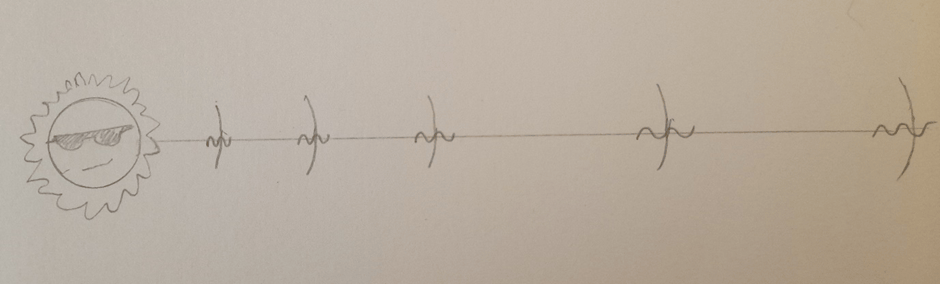
Figure 1: As Gravitational Density decreases from a Mass, so too does the Wavelength increase
This returns to the whole connected density, space, time concept. With Space being compressed closer to the star before returning to normal as it moves away, the photon shifts with it, from having a compressed wavelength to a less compressed one.
Gravitational Lensing:
What is Gravitational Lensing? It is the bending of light around a mass. When a large enough mass passes between a light source and us, it will literally bend the light around its body and the resulting new path will make the resulting light source appear from a different location in space. It’s quite fascinating.
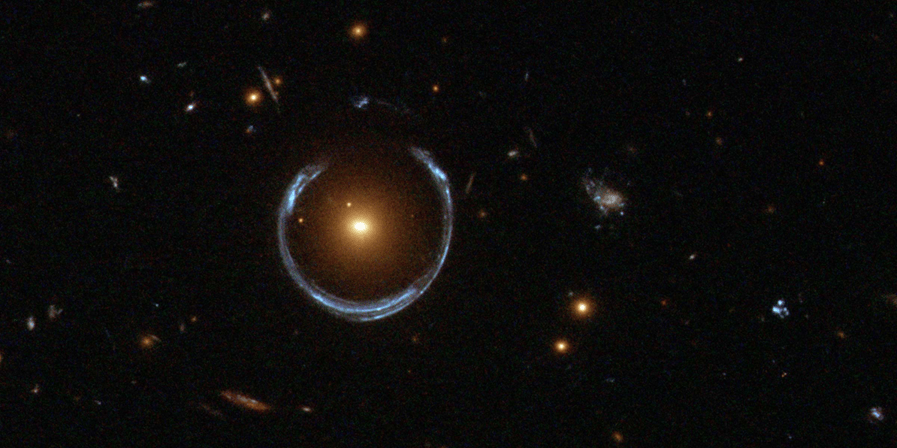
Figure 2: A large elliptical galaxy bending light from a small, blue galaxy behind it, forming this ring (Photo ESA/Hubble/NASA)
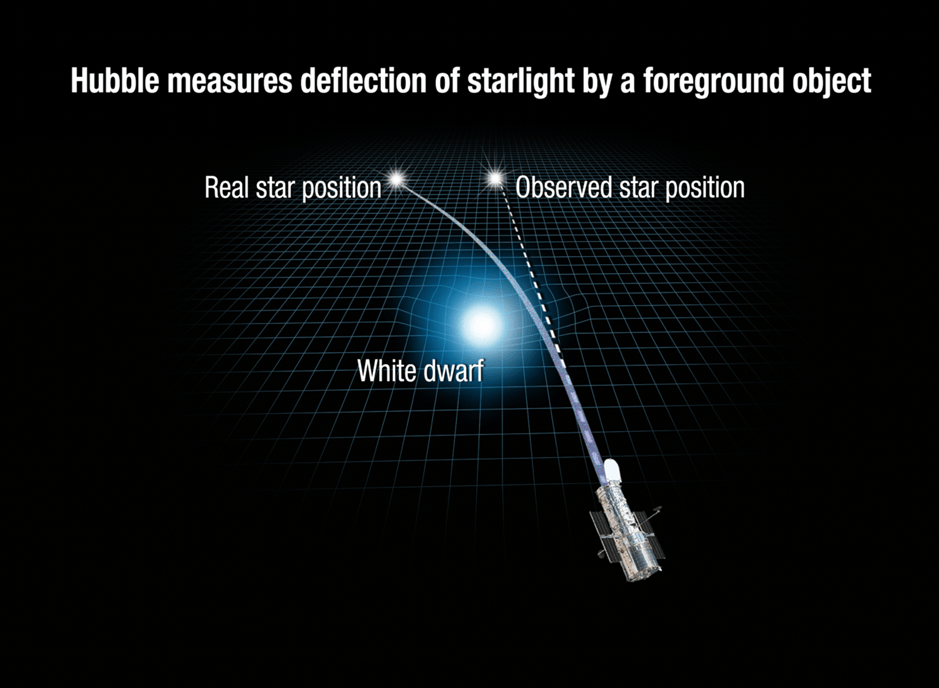
Figure 3: Anything large enough to bend light can be used, from galaxies to stars. Even planets, though the deflection would be very minute
Does our idea work with this? YES! And excitingly so (well, I think it’s exciting anyway).
And how does it work? Through good old refraction, that’s how. Snall’s Law, normally used to show the refraction of light through two mediums, (such as air and glass, or air and water) can also be refracted in my hypthosis, from Gravitational Density.
What is Refraction?
It’s pretty simple. It’s the movement of light from one medium to another. When the light beam approaches at an angle, and the density between mediums differs, the light beam will bend.
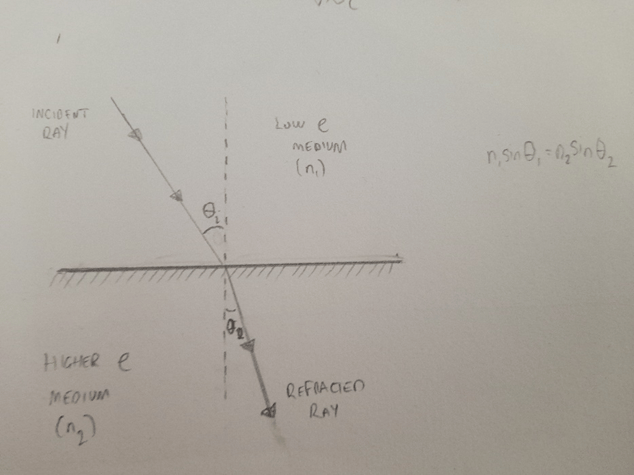
The reason the beam bends has to do with the shift in wavelength as it hits the new medium at an angle.
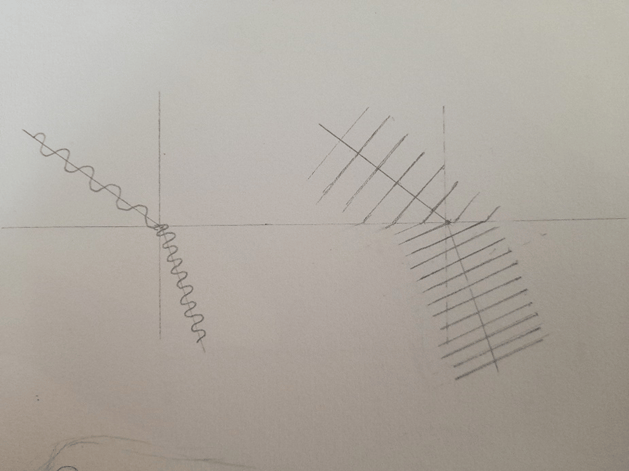
When light passes from a lower-density medium into a higher-density one, its wavelength shortens and this results in the beam “bending” towards the normal. Similarly, light passing from a denser medium to a lighter one with bend away.
How Would Refraction work in a vacuum?
Under normal rules we follow, light wouldn’t bend using this method, as there is no shift in medium. The Vacuum of space is just that. But from previous chapters we’ve established there is a density, a density of gravitation. Photons approaching a mass will experience its wavelength becoming more compressed (more blue), and the wavelength of photons leaving a mass will stretch (become more red).
So it stands to reason, light approaching (off-centre) from a source will bend towards the mass on approach and bend away as it exits. The greater the mass the more this bending will occur. So what would be a straight line without any obstructing mass will now take a new path, thus Gravitational Lensing. This works for galaxies, black holes, stars, and even planets will distort light from behind; just a tiny bit.
Review:
We have no idea if my model fits in with Mercury. I’m just not that bright enough to think it through.
Gravitational Redshift works with my model.
Gravitational Lensing works with my model.
Question/Things to ponder:
Are there other General Relativity phenomena that we could explore?

