Update from me before get into it.
I know I’ve been slack. I don’t work on my projects enough. I’ve been meandering around with my physics hypothesis for ages now. Distractions, other projects, exhaustion and good old procrastination have gotten in the way. What has driven me recently to work on it, is that I came across an article expressing a theory I had almost 20 years ago. Something I took to several professors with the hopes of gaining a PhD. They all shut me down. It’s understandable, but with my idea now actually considered, I’m also annoyed, annoyed that I didn’t get a shot at being the voice of that idea, and also annoyed that I thought about writing it down (even in my fictional writing) but never did. So that’s what I’m doing now, with this one. So that there is a record at least. I doubt it will lead anywhere. But who knows. At least it’ll be out there. And I enjoy pondering on it. D.M. – 28/Oct/2024
~~~
My hypothesis of Gravitation
In history first we had Newton’s description of gravity as the attraction of matter. This is how many of us still view gravity. Because it’s so simple to picture and works well in describing gravity in most scenarios, but at the end of the day, it’s wrong.
After that came Einstein. He described gravitation as bodies of mass warping space-time around it. But it doesn’t explain gravity on a quantum level, and though its predictions are spot on, it fails to tell us what gravity actually is.
My hypothesis is pretty much the same as Einstein’s. The big difference is that I think I can explain what gravity is. And this could also explore the quantum aspects of gravitation.
I’ve never gotten far with developing this theory because I lack something important – mathematics. But I did study physics at the bachelor and master’s level and I feel I have just enough of a foundation to present this as a distant possibility.
I know my idea is likely to be wrong. But the simplicity of it means I feel compelled to share it. That way others can ponder it and either cheer me on or disprove it (That’s the point of a hypothesis after all) … perhaps at the end of the day, all it does is help people picture general relativity in a more intuitive way. And I’m fine with that.
So let’s get into the details.
The Hypothesis:
- Gravitation is a consequence of the presence of matter within a field/space: (This is what Einstein said – so nothing new here).
- Gravitational Field obeys the conservation of energy (pretty standard stuff. If you’re not sure what that means think along the lines of Newton’s law: every action has an equal and opposite reaction).
And because of this
- The Gravitational field has a ground state that is distorted when in the presence of matter. This distortion exerts a pressure on matter in an attempt to return to its ground state (I call this the Gravitational Pressure, Gp)
I also have some ideas that this could link in with electromagnetic fields and the propagation of photons. But I haven’t explored this concept much and I think it’s way out of my league. But perhaps I’ll thought experiment it down the track and see where we end up.
Chapter One: The Basics
So, let’s begin with the basics.
Apologies in advance for all my terrible graphs and images.
Basically, there is a field all around us. It permeates all of space. At any time we’re subject to this field. But just like a +ve and -ve charge it is repelled in the presence of matter. This repulsion causes the field to stretch, and thus in turn, creates a potential energy within the distortion.
Looking at the image below: the straight line is the neutral state of the field in the horizontal plane. And the curved line is the new path. The red dot in the middle is the mass causing the distortion.
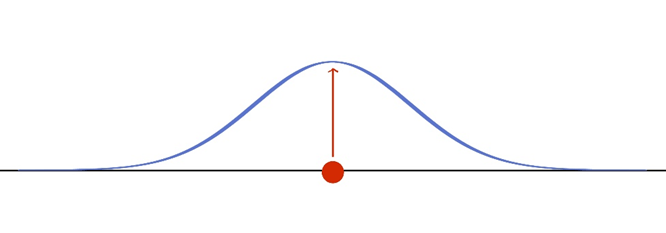
The field doesn’t like being on this new path, it’s trying to get back to its original state, exerting pressure downwards, like so:
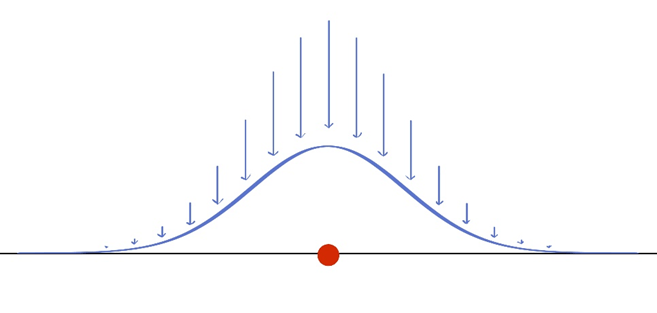
The further the field is distorted from its original path the more pressure it exerts trying to return to its neutral state.
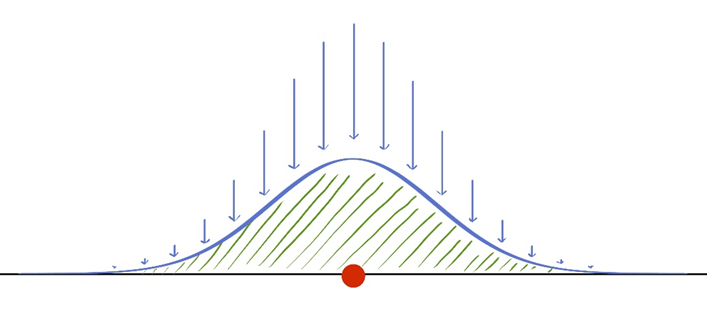
So our theoretical red mass point in the middle has a lot of potential energy bearing down on it.
Now, the thing is, we’re just picturing this in one direction. With one field line going left/right. But it would be happening in every direction simultaneously. So if we just copy this terrible image and flip it around a few times we see a pattern emerge.
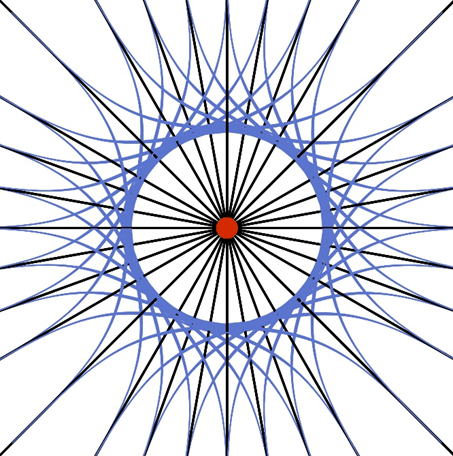
Not the best representation but my drawing program wasn’t happy with me copying, pasting and moving the same image several times.
The more times you copy and flip the image the more pronounced the sphere becomes, and will develop further and further out. Stronger closer to the mass, fainter the further out.
The Gravitational Constant:
So, I’m gonna to on tangent for a little bit, and propose a question.
And that question is. What exactly is the Gravitational Constant? I don’t think anyone has ever explained exactly what it is. And I couldn’t find anything on the internet. People say, it’s just a constant. But constants come from somewhere, they mean something.
If we look at the units:
The Gravitational Constant is 6.67×10⁻¹¹ N.m2/kg2
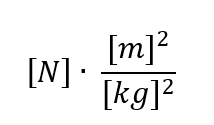
With N being the Newton which is a unit for force. It means the amount of force required to shift a one kilo object one meter per a second squared. (per a second square is acceleration).
If we switch the N with its fundamental units we can expand G to:
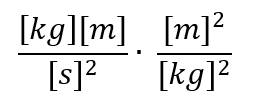
If you’re not aware about units this is the same as what we just had, it’s just expanded out. The N really, just makes things look neater. We can then add them together or cancel them out to give us the most basic units:
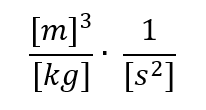
Now our reimaged units are: meters^3 per kilogram and per sec^2.
So now we’ve broken the units down again. What are these units? Well, the second is easy. It’s just acceleration, taken from the Newtonian part. The first part though is interesting. These are the units for density, but reversed. Applying the acceleration turns this into a unit denoting a force. So basically this looks like anti-pressure in 3 dimensional space.
What on earth is anti-pressure? Is that even possible?
I guess instead of a force pushing outwards, it’s a force that draws inwards. From a warped space perspective it just looks like normal pressure.
But if that’s the case, why would space exert this inward-pressure at all?
Well, if the gravitational field lines are stretched then it’s a given they’d rather be un-streched (yes that’s a technical term) – and given every reaction has an equal and opposite reaction, that would suggest there is an opposing force trying to stop that stretching in the first place. Pushing downwards, the gravitational field is exerting pressure in the normal sense of the word. This would appear like anti-pressure from our perspective, but is like normal pressure from the gravitational field perspective.
So while the field is being stretched out, the inward “anti-pressure” is trying to bring it back in … and that’s what I think G is. It’s the elasticity of space trying to return to normal.
Chapter 02: Two Body System:
Okay, so we have established that a mass will stretch the gravitational field, Changing the gravitational density and exerting an “anti-pressure” on said mass.
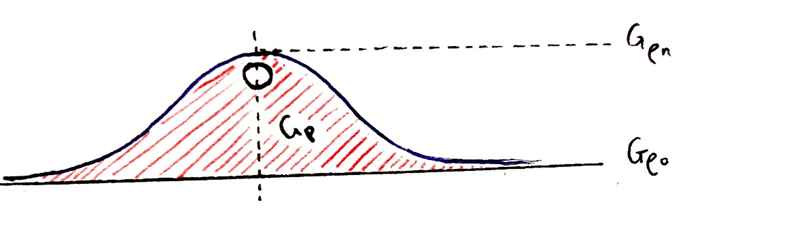
Gρn should be Gpn which is the stretched Gravitational Pressure.
Gρ0 should be Gp0 and is the neutral state of Gravitational Pressure.
And Gp would be the Gravitational Energy.
So let’s try and picture what this gravitational pressure would look like.
The gravitational pressure “felt” by the mass will be even from all directions. If we look at our image we see that the pressure from the left side of the mass will equal the pressure from the right side. They are perfectly even.
But, what happens when we introduce a second mass?
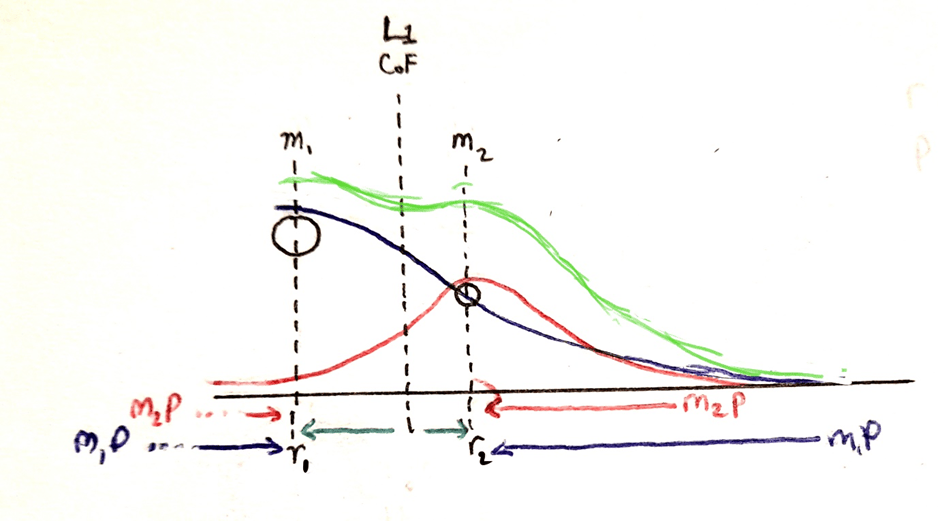
If we have two masses then the Gf (gravitational field) will stretch from both, with both influencing the space around them.
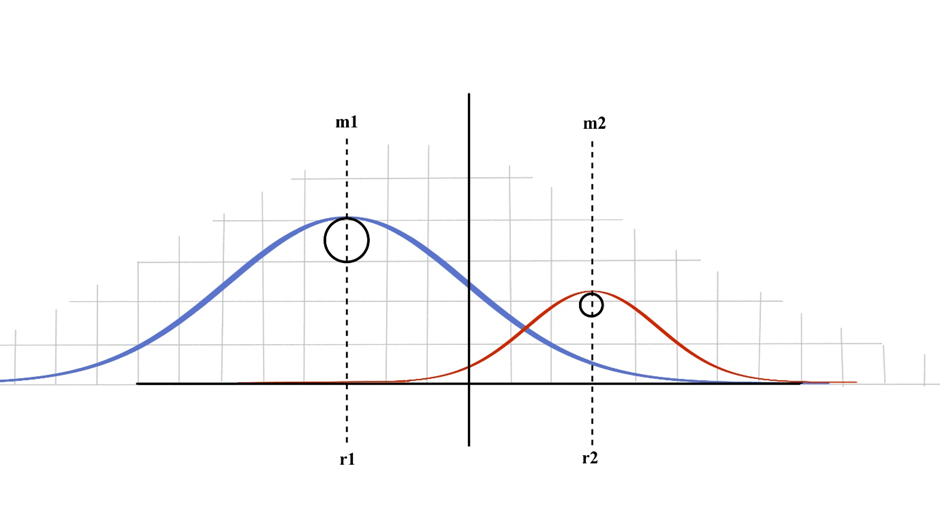
If these masses are by themselves then the field would be even on all sides for that mass. (blue for the larger mass, red for the smaller). The subsequent pressure would keep everything within the centre like we discussed in Chapter 1.
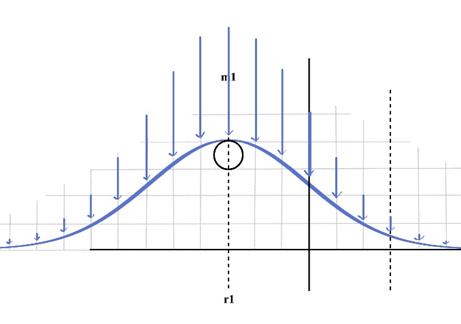
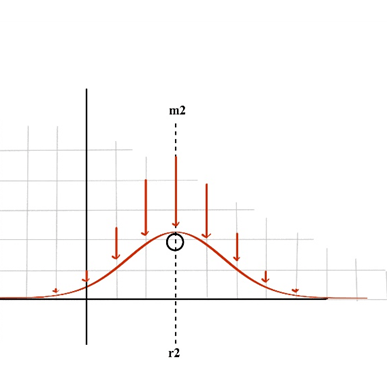
But if both these masses overlap then the resulting gravitational field will warp around both. Combining the Gravitational Field Distortions of both to produce a new shape. which is what we expect with gravity. It’s accumulative.
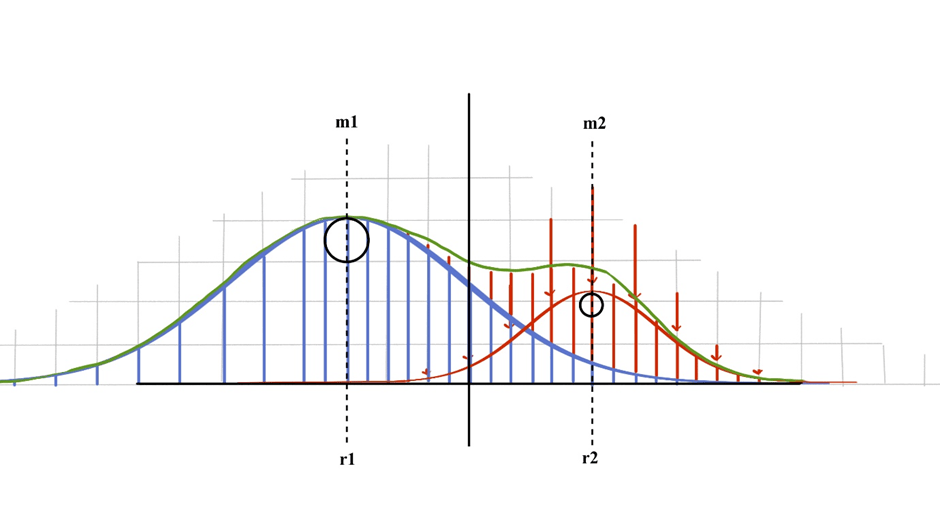
Having more than one body changes the entire dynamics of gravitational pressure in the system.
The smaller mass (we’ll pretend that it’s a sun/planet system, even though the image I drew would be more representative of a larger and smaller star (for a planet the second mass would be MUCH smaller)) is now caught in the Sun’s sphere of influence (the area around the planet has significantly stretched from what it would be like if the smaller mass was alone). But it isn’t completely dominated by the larger mass, it still has its own region. Like an island within the larger system. The larger the small mass is the larger that island would be, and the smaller it is, the smaller that island.
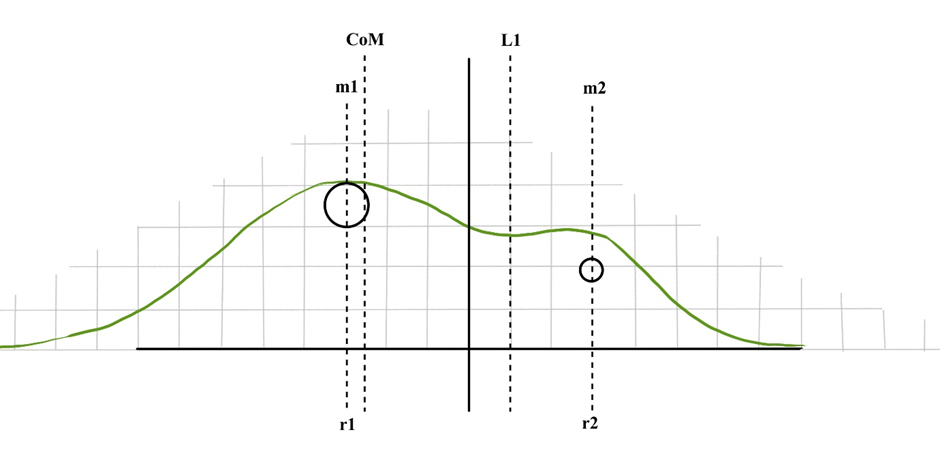
Returning to the graph images. We no longer have a nice, clean bell curve for the stretched space. It is unbalanced. The pressures on either side of both masses will no longer be equal. And this will affect both masses.
The new curve also shows us two things. It shows the smallest shift of the Centre of Mass. Both bodies would be drawn to this new point.
And the second is the small dip between both bodies near the smaller mass. This is the spot where the gravitational pressure between the two masses is equal. Anything sitting here would feel equal pull towards both masses and therefore wouldn’t be drawn to either … This is called the first Lagrange Point.
Now here’s the interesting thing. In three-dimensional space, anything floating around will be subjected to bother masses. Even when that object is well in the sphere of influence of the smaller mass, the pull from the greater mass will still be felt. Even well outside the smaller masses influence, the object would have the faintest of interactions with that smaller mass.
This applies everywhere EXCEPT in direct line between both bodies. On a one-dimensional line, the influence is determined by which side of the Lagrange point the body sits.
So here’s a picture for both bodies and the resulting Gp felt by them.
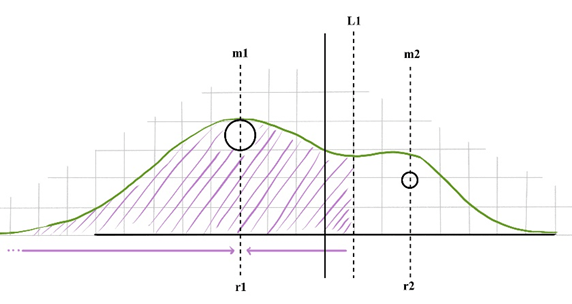
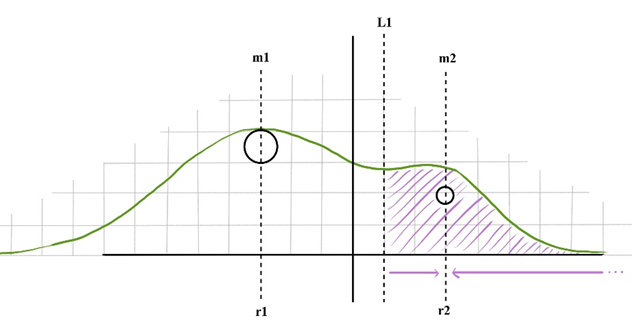
Another interesting consequence of this quirk is that both bodies are now cut off from part of their normal gravitational pressure on one side. What once was even and keeping everything firmly in the middle, now has a greater pressure pushing on the outside of the system compared to the side with the secondary body.
This results in both bodies being drawn towards each other. Just like in Newtonian Gravity.
Now my maths isn’t great. I can’t derive formulas for the life of me. But I can express the systems in pressure and distance.
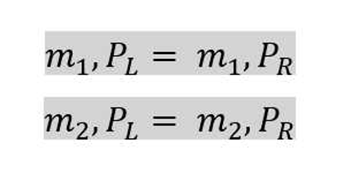
m1 is the mass of the larger body and m2 is the smaller mass. PL is the pressure on the left side, and PR is the pressure on the right side. Putting them together we get our mass/pressure relationship. By themselves both sides are equal.
Adding both separate formulas together we can calculate the new pressure experienced by their combined influence for either side (with the large mass being the point of reference).
Left side of Mass 1:

Right side of Mass 1:

This now shows the total gravitational pressure of the combined system relative to the Main Mass.
We can also show the new total pressure experience by either body (the purple filled area in figures 2 and 3), Where Lr is the Lagrange point position:
Total Gp experienced by Mass 1:

Total Gp experienced by Mass 2:

So coming back to the two body image we can now apply the direction of pressure. Shown with the little arrows below.
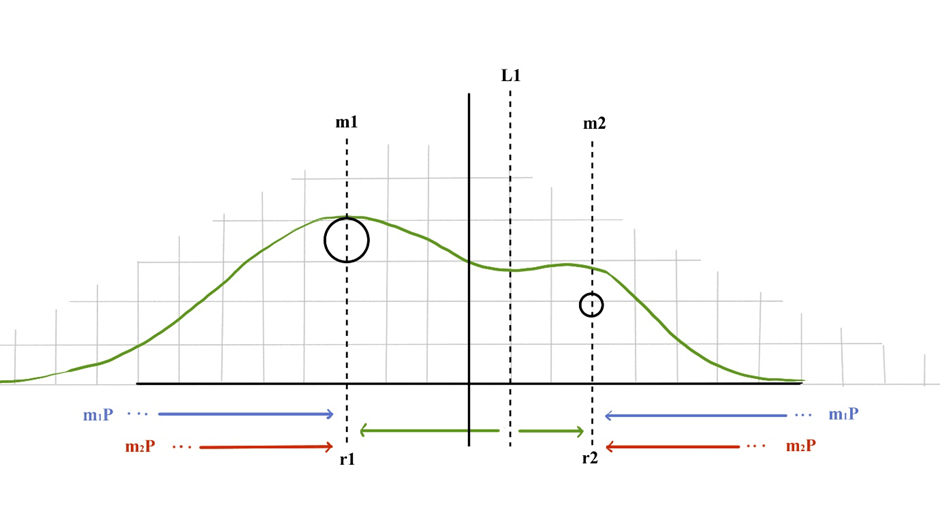
As you can see the combined pressure on the left side of M1 (the blue and red Pressure lines) are now much greater than the pressure it experiences on the right side (The green line – remember, we only count the pressure from the Lagrange point to the mass)
We can also see that Gravitational pressure on the inside (Green line) of the smaller mass is much smaller again, compared to the force pushing from the other side. So that would result in much more pressure on the outside, exerting a greater force against the smaller mass compared to the larger. The further away the masses are, the less pressure experienced by either of them from the outer side.
This effect only applies when the two bodies are directly in line. If we look from a different angle, the combined pressures still apply, but there is no cancelling affect. Their masses are simply seen as one.
So, for example. We’ve been assuming these bodies are orbiting. Like two suns, or one sun and one planet. If the bodies weren’t orbiting and they were just sitting it space, they would “fall” towards each other.
The smaller body would move at a greater rate as it has a much lower inner pressure to counter the combined outer pressure.
The larger mass is also, still unbalanced, with the inner pressure from the Lagrange point to the mass still being smaller than the combined outer pressure. It might have less of an imbalance than the smaller mass, but it’s still imbalanced. So the outer pressure wins as well, pushing it towards the smaller mass.
The difference in imbalance means that the smaller mass is being pushed inwards at a greater rate than the faster one.


I only know anything much about Newtonian physics. Almost zero about Quantum physics and not enough maths to grok that in even the Special Theory of Rel. I suspect the word descriptions of Relativity I’ve read are unreliable, the claims seem inconsistent to me including treating quantities as both vector & scalar. And categorisation of light etc as both quanta & waves. All based on a founding assumption that the speed of light through a vacuum is fixed. But is the rate of electromagnetic propagation a speed? In electronics but not physics, the speed of “individual” electrons even in an induced current, through eg copper, seems to be much slower than the rate of propagation OF the inducement of current flow, which is about C/5. In investigating what Einstein sought to explain, I’ve only read why Maxwell regarded eg radio as like light. And a description of how the propagation speed was measured. Unlike the silly nonsense about that measurement that I originally read.
Anyway … many thanks for sending this. So far I’ve only read a little between murdering caterpillars, and wonder if the pressure you refer to is like fluid eg air pressure? If so, I expect that even in a vacuum less dense objects of the same mass would fall faster than more dense objects, since fluid pressure is exerted on the outside surface which would mean more force on an object with more surface area.
I could share what you’ve written with a few people that know far more physics, or give you contact info for them. Otherwise I can imagine you could discuss this on eg Reddit or Slashdot, as well as on more academic forums, but you might have more plagerisation (mispelled?) to worry about.
LikeLike
Hey David, nice to hear from you.
Need some time to ponder on things (on everything in general, lol. I’m a bit slow I thinks. Need to mentally prepare myself to discuss how to make mac n cheese, let alone something more complicated.)
As for the flow of “electrons” through wires. The electrons themselves don’t actually travel along the wires, they “bounce” between their neighbouring atoms. It’s a transfer of energy that travels along a line causes the “flow”. Not physical movement. It’s a bit brain breaking. I’d have to read up on it properly to remember how exactly it works.
You’re probably right about the density of mass causing different rates of attraction. I’ve lightly contemplated this already (kinda, set a brief discussion for the next chapter, if I finish working on it and post it that is) — and yes, it would go against everything we’ve seen so far. But there might be a loophole or two. Which I’ll explore in that post. But pondering right here and now, I could argue that the differences in masses are so vast, that any “variable falling rates” would be negligible … like how Newtonian gravitation works perfectly fine at non-relativistic speeds, because the estimation is good enough and we don’t see any drift unless we travel at much faster velocities … or that we don’t even have to worry about the mass of a ball when we drop it, because the mass of Earth is so overwhelming that the Earth’s movement to the ball is almost zero.
I suspect I’ll come unstuck as I explore more and more ideas. I’ve come back to this for several years now, and I recall getting stuck at things like Mercury’s orbit and what not (might have an issue with variable Lagrange points effecting orbital velocities as well) <<< this ultimately is the problem with not being very maths literate. If I knew how to write equations to follow my ideas I could test them. That would give definite answers to my ponderings.
But I’m enjoying the process of just thinking this stuff out. It’s fun, and distracting from all the work I should be doing, always a win. Ha.
I have no desire to take this to Reddit or whatnot. I can’t communicate effectively at the best of times and they might take the fun away. I just want to plod along. Maybe one day I’ll turn it into a YouTube thing and then I can have people tell me how wrong I am. But right now. I’m just happy to be wrong by myself and create my potentially fictional theory.
LikeLike
On further thinks, I guess eg “light pressure” is calculated by dividing a force by the area of a wavefront rather than illuminated area. And unlike static fluid pressure is not always even around the surface, but more like wind pressure.
LikeLike